Albanian consumers have individual consumption per capita purchasing power equal to 48% of the European Union average and income per capita equal to 43% of the European Union average.
For consumption according to purchasing power, Albania ranks second to last in Europe, leaving behind Bosnia, while for per capita income it is at the same levels as North Macedonia and again leaves behind Bosnia. (data for Kosovo is missing).
However, when it comes to food prices, Albanians are paying increasingly more expensive prices compared to the European Union average, measured by purchasing power.
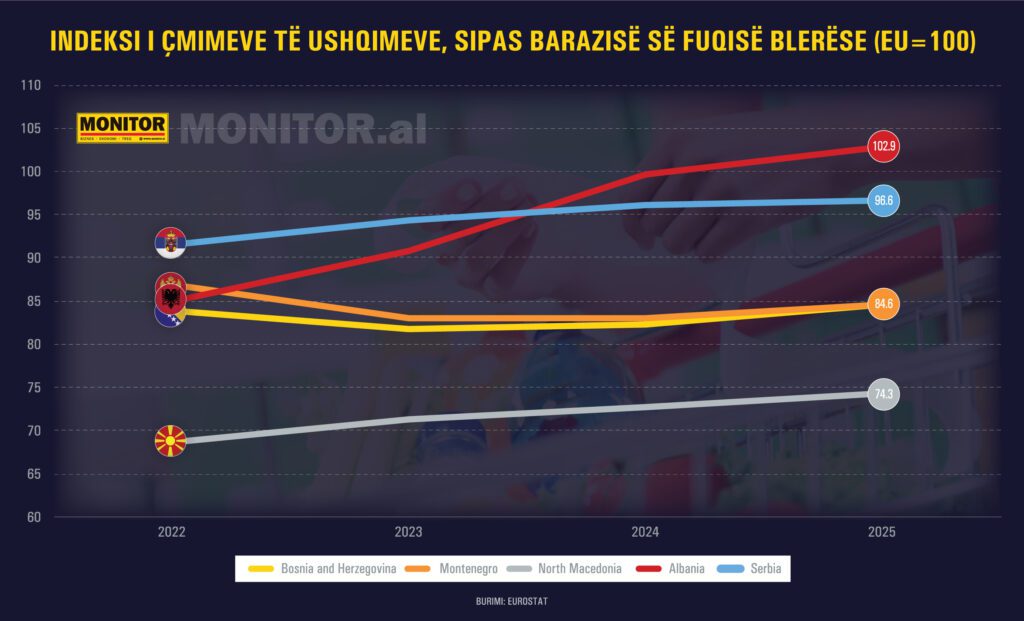
The latest Eurostat data, expected to be released today, compiled by Monitor, show that food prices are for the first time around 3% more expensive than the European Union average. Prices have risen rapidly, from 85% of the EU average in 2022 to 99.6% in 2024, to 102.9% in 2025.
Simply put, a food basket that costs an average of 100 euros in the European Union costs around 103 euros in Albania, measured according to purchasing power, while the per capita income of Albanians is less than half the European average.
The Eurostat indicator does not measure prices in nominal terms, but rather the index of the price level according to purchasing power parity (PPP). This indicator compares how much the same basket of goods and services costs in different countries, eliminating the effect of exchange rates and differences in income levels.
A level above 100 indicates that prices are higher than the European Union average, while a level below 100 indicates that they are lower.
Albania is the only country in the region where food prices have exceeded the EU average.
In contrast, other countries in the region remain significantly below the European average. Serbia ranks second with an index of 96.6, although prices there have also gradually increased from 91.5 in 2022.
Montenegro and Bosnia and Herzegovina have almost the same price level, 84.6% respectively, while North Macedonia remains the cheapest country in the region at 74.3% of the EU average. Data for Kosovo is missing.
A year ago, Albania equaled the EU in the price index for non-alcoholic beverages, while this year it has surpassed European countries only in the food indicator (which in 2024 was 99.6%). Including non-alcoholic beverages, the index in 2025 is 103.8%, up from 101 in 2024.
The difference becomes even more apparent when compared to income levels. While Albania has a per capita income of 43% of the European Union average and individual consumption of 48% of the EU average, food prices are above the European average.
This means that Albanian families have to spend a much larger portion of their budget on food compared to citizens of wealthier European countries.
While the Albanian government has the ambition to bring Albania into the EU as soon as possible, it seems that the country is approaching Europe in terms of prices much faster than in terms of income. This phenomenon reduces the real purchasing power of families and is one of the reasons why citizens’ perception of well-being remains significantly more negative than economic growth indicators suggest.
Although Albania continues to be the most agricultural country in Europe, where agriculture contributes about 15% of the economy, up from the 2% that is the European average, we are forced to consume expensive imported products, or even domestic products at high prices due to the lack of competitiveness. Just a few months ago, the price of tomatoes in the country jumped to 400-600 lek per kg.
Prices so expensive that even foreigners complain
Albania is not only expensive for food measured by purchasing power, but also in direct prices, especially for products in supermarkets. Earlier, Researcher Ilir Ciko presented some preliminary findings of the study “Market Competitiveness Index (MCI) for the Western Balkans: 2026.
“For the average Albanian consumer, the results show that the products he buys in European markets in Albania, stripped of the different effect of VAT, cost on average 83% more than the exact same products sold by the exact same companies in the European market, while his purchasing power is only 41% of the EU average,” the study said.
Complaints about high prices don’t just come from domestic consumers. On travel forums like Reddit, Tripadvisor, and groups of tourists visiting Albania, one of the most frequent comments is that supermarkets in Albania are more expensive than expected, with even some basic products being priced comparable to those in Western European countries.
Tourists often point out the contrast between the country’s low income and the relatively high prices of food in the markets.
On TripAdvisor, in the topic “Where can you buy food that isn’t expensive?”, a visitor writes that supermarkets in Albania are “very overpriced” and that he had never seen “such absurd prices,” especially comparing the country to North Macedonia.
In another TripAdvisor discussion about Tirana, users say that prices in supermarket chains are “very high” and “higher than abroad.” Also on Reddit, in r/Albania, tourists and foreigners temporarily living in the country complain that basic purchases in markets or small shops in Durrës have cost them more than they expected.
In a recent Reddit discussion, a tourist visiting Tirana complained that in large supermarkets a liter of milk cost around 300 lekë, chicken breast 1,700 lekë/kg and a 500-gram package of muesli over 1,000 lekë, prices he considered “surprisingly high” compared to prices in restaurants and bars.
While a tourist in Durrës reported: “I bought 2 tomatoes, 1 lemon and 1 apple for 3 euros”, saying that the real prices turned out to be much higher than those he had seen on international cost of living comparison sites./ Monitor