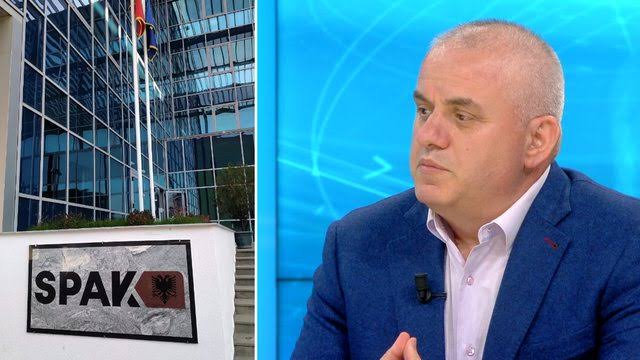
Journalist Artan Hoxha has criticized the way in which SPAK is handling certain investigative issues, claiming that the institution is dealing more with distributing information to the media than with fully investigating them.
Invited to the show “The Unexposed”, Hoxha stated that details and identities of people are being published without first clarifying their role in the file, while such information is then being distributed in the media.
The journalist emphasized that the priority should be to fully clarify the issues and not to distribute pieces of information.
He said that the published materials also mention the identification of Alfred Hamzaj, asking why such names and details are included without first providing full explanations.
According to Hoxha, if this information is put into a file and then distributed to the media, the question arises whether the focus is on the investigation or the publication of the materials.
The journalist also emphasized that this is a case worth around 3 million euros, adding that in the meantime other people have ended up in prison for much smaller violations.
He urged the justice system to act and move forward with investigations, instead of allowing such cases to remain for a long time without a clear conclusion.
Excerpt from the discussion
Artan Hoxha: …we have Alfred Hamzaj and he gives his identification there.
Ylli Rakipi: But he himself doesn’t come up in the conversation?
Artan Hoxha: Well, that’s exactly what I’m saying. But why are these things included and not explained? You’re including these things and then distributing them to the media, uh, distributing them to the media. So what are you doing? I say investigate, act, don’t find a… a 2021 proceeding.
Ylli Rakipi: But since this is also the time of revolution, maybe now… maybe a head is needed…
Artan Hoxha 1: Oh Ylli, there are 3 million euros there! Ylli, the other one went to prison for two boxes of fish. Here are 3 million euros.
The paradox of the SPAK files/Balluku case
Artan Hoxha’s statements bring back to attention the debate over how information from various SPAK files is made public.
While in other cases, details from investigations have found their way to the media through constant leaks of information, in the case of former Minister of Energy and Infrastructure, Belinda Balluku, the institution has insisted on maintaining investigative secrecy.
SPAK claims that the files filed with the Assembly contain data that constitute an investigative secret and should not be made public.
However, questions arise as to whether all of the material deposited can be considered secret, or only certain parts of it. All the more so when it comes to an investigation related to suspicions of tender manipulation and use of public funds, issues that by their nature carry high public interest.
It is precisely this contrast that fuels debates about the standards followed in the management of sensitive files: on the one hand, investigative fragments on various issues are published, while on the other, maximum confidentiality is required for a file that has aroused extraordinary public and political interest.