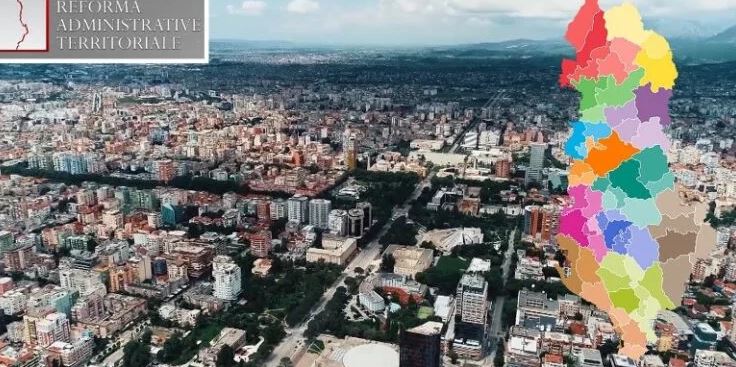
The local map of Albania is being rewritten, Rama launches the movement for the merger of municipalities, meets with political leaders at the pink headquarters, here is what Territorial Reform 2.0 envisages.
Prime Minister Edi Rama gathered the leaders of the Socialist Party in the regions in a meeting at the pink headquarters yesterday, where it is learned that the focus of the discussions was the new territorial division. While the opposition has come out against it, it seems that the Socialists are not giving up on the objective of reducing the number of municipalities. It is learned that the report of the co-chair of the Commission for Territorial Reform, Arbjan Mazniku, which was not made public during the tense session in the Parliament on Thursday, was presented to the Socialist leaders at the pink headquarters.
The new project presented by Mazniku foresees that the number of municipalities will not exceed 50, from the current 61. The draft law is expected to be submitted to the Assembly within July, after being approved by the votes of the socialist deputies in the Special Committee for Territorial Reform. Also, in September, the project of the new territorial division is expected to be reviewed in the parliamentary committees, although the opposition has openly opposed it.
The Socialists plan to approve the new territorial division in Parliament by the first week of October. This vote is expected to require 84 votes, which the Socialist majority does not have alone, so it seems that it will also require the support of three deputies from Tom Doshi’s PSD. Meanwhile, the Democratic Party has come out against the reduction in the number of municipalities, demanding that separate municipalities be created in some areas.
What happened?
Meanwhile, let us recall that details and assumptions have already emerged from the final report of the Special Parliamentary Commission for Administrative-Territorial Reform, which is said to propose a deep review of local government in Albania, paving the way for the reduction of the current number of 61 municipalities. The document does not yet present a final map or an official list of units that will be merged, but it builds a diagnosis of the system, defines the evaluation criteria and presents four basic scenarios on which a political decision is expected to be made.
The analysis is based on data from the 2023 Census, the Ministry of Finance, INSTAT, and public hearings with over 3,500 citizens and local representatives in 11 regions of the country. In its diagnosis, the report notes that although the 2014 reform reduced fragmentation from 373 to 61 municipalities, it did not solve all structural problems. Today, although municipalities legally have 41 functions, they cover on average only 15.8 out of 34 measurable functions. Over 42 municipalities cover less than half of their legal duties and only five of them manage to exercise at least 24 functions.
To assess the sustainability of each unit, the report sets five criteria with different weights: the financial and functional criterion with 30%, the economic criterion with 20%, the demographic criterion with 20%, the distance and road access with 15%, as well as social, cultural and historical cohesion with 15%. The latter can also serve as an obstacle to unification in cases of protection of national minorities. The document examines four scenarios for the future. The first scenario maintains the map of 61 municipalities through an asymmetric decentralization. The second scenario requires deep consolidation with large unifications, but risks removing services from the citizen.
The fourth scenario limits municipalities to basic services, leaving other functions to the central level. The most likely variant recommended by the report is the third scenario, which proposes selective mergers only for the weakest units, combined with the creation of a new regional level (over 12 counties) that will take on specialized functions such as waste management, transport or EU projects. From the combination of financial, demographic and geographical indicators, some municipalities emerge as the most exposed to mergers.
Rrogozhina is presented as one of the most critical cases with only 8.3 points in functionality and is proposed for merging with Kavaja (23 minutes away). Memaliaj with around 6,600 inhabitants is seen as a natural candidate to merge with Tepelena (12 minutes away), while Këlcyra with 4,400 inhabitants is linked to Përmet. Delvina risks merging with Saranda due to low financial indicators, while Fushë-Arrëzi, although weak in numbers, has difficulty merging with Vau e Dejës or Puka due to the mountainous terrain and the distance of 92 minutes.
On the other hand, municipalities such as Pusteci (with less than 2,000 inhabitants), Konispoli, Finiqi and Dropulli may be exempted from the general rule of unification due to constitutional guarantees for national minorities and the protection of historical identity. The report emphasizes that the mechanical unification of two poor units does not in itself create a strong municipality, so the reform will be accompanied by a new financing formula. The anticipated calendar aims for the assessments and legal package to be approved by 2026, with the aim of the new administrative-territorial map being fully implemented in the local elections of 2027.