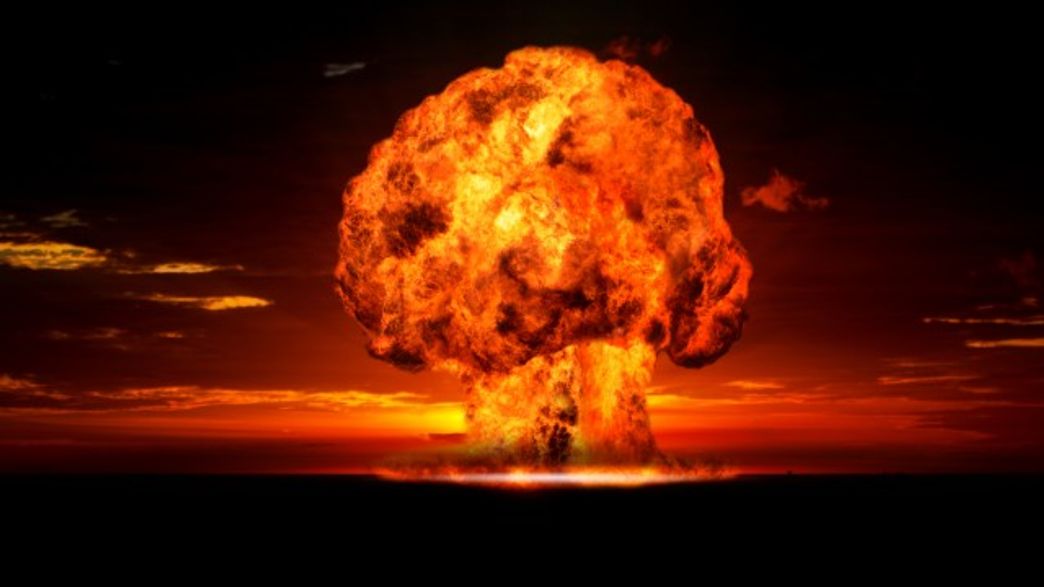
An international team of researchers, led by Italian scientist Luca Bindi from the University of Florence, has discovered a new material that is thought to have formed during the first nuclear explosion in history. The study, published in the scientific journal PNAS, focuses on “trinitite,” a type of green glass that formed in the New Mexico desert after the “Trinity” nuclear test in 1945.
During the analysis, the researchers discovered inside the glass fragments metallic microdots that contained a previously unknown crystal structure. The new material consists of calcium, copper and silicon and is classified as a “clathrate”, a material with a special microscopic cage-like structure. According to experts, this material was created due to the extreme temperatures and pressures produced by the atomic explosion.
Scientists say clathrates are considered very important for future technologies, as they have the ability to “lock” atoms and molecules within their structure, changing the physical properties of the material. “Studying these structures helps us understand how atoms organize themselves under extreme conditions and opens up new possibilities for the creation of advanced materials,” said Luca Bindi.
The “Trinity” test, conducted on July 16, 1945, as part of the Manhattan Project, was the first nuclear explosion in history and was carried out in the Jornada del Muerto desert in New Mexico. The name “Trinity” was chosen by physicist J. Robert Oppenheimer, considered the “father of the atomic bomb.”