Türkiye Today presents the “Flamingo Revolution” as a revolt against the way of governance and not against foreign investment, dealing a strong blow to Bablok…
Edi Rama has received strong criticism from Ankara regarding the protests that have erupted in the country in recent days.
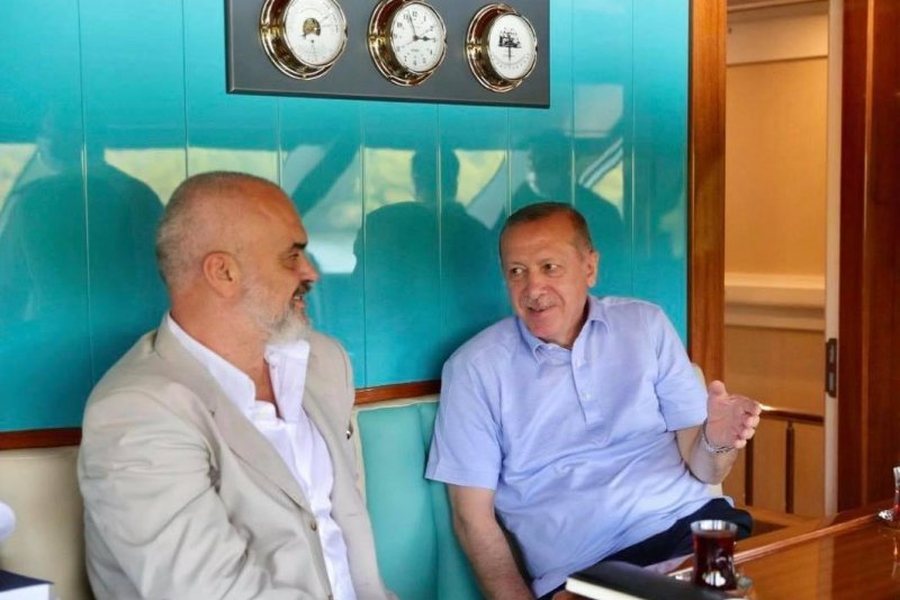
Relations between him and Turkish President Recep Tayyip Erdogan have been considered for years among the closest in the region. However, in recent months, signals have begun to emerge suggesting a cooling of relations between the two leaders, especially after Tirana’s rapprochement with Israel, a development that has not been well received in Ankara.
In this climate, an analysis published by the Turkish media “Türkiye Today” has attracted attention, which does not spare criticism of the Albanian government and the way it manages the debate on tourism projects in the south of the country.
Unlike the official narrative that has placed emphasis on opposition to the development of the Zvernec area and the Narta lagoon, Turkish media argues that what has been called the “Flamingo Revolution” essentially represents a revolt against the way Albania is governed.
According to the analysis, the protests are not just about the environment, luxury resorts or foreign investors, but about a deeper dissatisfaction of a generation that feels excluded from decisions that affect the country’s future.
“The story is not really about the Trump family, nor just about a luxury resort,” writes Türkiye Today, emphasizing that the debate has turned into a discussion about transparency, accountability, and how public decisions are made.
The analysis also focuses on Edi Rama’s long-term dominance in Albanian politics, noting that many of the young people protesting today have not known another political reality in their lives.
According to Turkish media, this is why the movement has managed to unite different social and political groups, which share the same concern: the lack of transparency and the feeling that important decisions are made without the involvement of citizens.
The article emphasizes that the protesters are not against foreign investment or economic development. On the contrary, they demand that strategic projects be accompanied by more transparency and public debate.
Article
When videos of protesters confronting security guards near Albania’s protected coast began circulating on social media, much of the international media chose a familiar interpretation: the Trump family had arrived in the Balkans.
Jared Kushner and Ivanka Trump were planning a multi-billion dollar luxury resort on the island of Sazan on the southern coast of Albania. However, environmentalists opposed the project and thousands of citizens took to the streets in protest. The debate quickly spread on social media.
It was an easy story to tell. But it was also an incomplete story.
What is being called the “Flamingo Revolution” in Albania today is not essentially related to the Trump family. It is not even just about a luxury resort.
This is about a generation that increasingly feels excluded from the decisions that determine its future. It is about transparency, accountability, and the question of who should decide how a country that has been trying to move closer to European standards should develop.
The flamingo became a symbol of this movement because the proposed projects are located near the Vjosa-Narte lagoon, one of the most important protected ecosystems in Albania and the habitat of many migratory birds, including flamingos.
Protesters adopted this bird as a symbol of resistance, and its image quickly spread from Tirana to Albanian communities in New York, Washington, London, and Paris.
The turning point came when footage was released showing a protester being forcibly removed from near the project site. The footage transformed a local environmental dispute into a national debate about power and privilege.
A move beyond traditional politics
For many young Albanians, the project began to symbolize something much bigger than tourism development: the feeling that their voices are only heard after decisions have been made. This frustration has been building for years.
Prime Minister Edi Rama has dominated Albanian politics for more than a decade. Before becoming prime minister, he served as mayor of Tirana. Many of the young people protesting today have never known a different political reality.
At the same time, opposition leader Sali Berisha remains one of the most important figures of the post-communist period in Albania. For a large part of Generation Z, the Albanian political landscape seems stuck between the figures who have dominated the country’s political life for decades.
This helps explain why the “Flamingo Revolution” has attracted people who would normally have little in common.
Environmentalists march alongside nationalists. Left-wing activists walk alongside conservatives. Young professionals, students, and families share the same streets and the same protests.
The strength of the movement lies precisely in the fact that it is not built around a traditional political party.
The participants are not united by a common ideology, but by the conviction that the future of Albania should not be negotiated behind closed doors.
Transparency test for foreign investments
This does not mean that the government’s arguments are baseless. The growth of tourism has transformed Albania. Tourism today constitutes one of the main pillars of the national economy. The number of visitors continues to grow, foreign investments are increasing and Albania has become one of the fastest growing tourist destinations in Europe.
From the government’s perspective, projects like the one supported by Jared Kushner represent an opportunity to attract international capital, create jobs, and accelerate economic development.
The problem is that many Albanians no longer believe that economic development and public accountability go hand in hand.
For them, the question is not whether Albania should welcome investment. The question is whether investment should come without transparency.
Precisely for this reason, attention to urban planning decisions and land classification has taken on political importance. The debate is no longer about a single project. It is about trust in institutions. And trust, once lost, is difficult to regain.
What makes the “Flamingo Revolution” particularly interesting is the fact that it reflects a broader trend that is emerging beyond Albania.
Across Europe and beyond, younger generations are showing less and less interest in traditional ideological clashes and are focusing more on issues of governance, transparency, and quality of life.
They are often willing to support development, but they also demand a seat at the decision-making table. In this sense, Albania’s flamingos are telling a much bigger story.
This movement has already revealed something important.
The generation that grew up during Albania’s transformation is demanding a greater role in determining what comes next.
The “Flamingo Revolution” is not anti-America. It is not anti-investment. And, despite media headlines, it is not just about the Trump family.
Albanians want investment and development. They want Albania to become one of Europe’s greatest success stories.
But the question being asked today on the streets of Tirana is whether this transformation can happen without sacrificing transparency, public trust, and the right of citizens to influence the future of the countries where they live.
Protesters are not rejecting development. They are seeking to have a voice in it.
And this is why the number of participants continues to grow. Because they believe that at stake is not just a development project, but the future of Albanian democracy. /Pamphlet