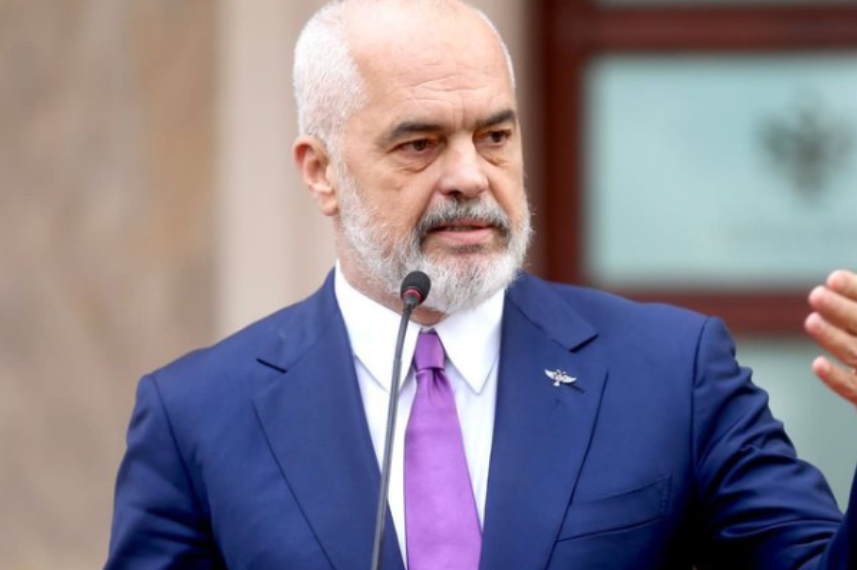
Prime Minister Edi Rama has reacted on the social network X to reports by international media, including CNN, regarding the protests of recent days against the discussed project for tourism development in the Zvërnec area.
In a long post, Rama states that the protest held this Saturday has gathered around 2,000 participants, while according to him, even at its peak, participation did not exceed 8,000 protesters.
The head of government raises questions about how, according to him, a local protest has turned into an event with international resonance, speaking of a large gap between reality and the way it has been presented in the media space and on social networks.
In his reaction, Rama sharply criticizes what he calls “digital hysteria,” claiming that manipulated images, fabricated claims, and coordinated methods of amplification on the network have been distributed around the issue.
Rama emphasizes that currently there is no final project, no building permit has been issued and no construction work has begun. According to him, there is only a vision and a plan to turn Albania into an elite tourist destination, guaranteeing development with a positive impact on the environment.
Rama’s full reaction
“To @CNN International and to all the countless media outlets, large and small, along with all the well-intentioned content creators on Facebook, X, Instagram, TikTok and every other platform that shapes the global debate today, I would very much like to convey the following message:
As we speak, today’s protest has gathered around 2,000 participants. It’s the lowest turnout so far, but even at its peak the number of participants never exceeded 8,000 people.
So how is it that what much of the world has seen in recent days seems so big, so dramatic, and so impressive?
At some point, when the orchestrated digital hysteria of these days has passed and emotions have calmed down, the democratic world should take a closer look at how the gap between reality and the way it is presented became so wide.
Not just for this particular case, but as a symptom of something much bigger.
How could a small country become global news for reasons so disconnected from reality on the ground?
How could a local protest with several thousand participants turn into an international spectacle?
How could assumptions turn into facts, narratives into verdicts, and speculations into accepted truths, before the basic facts were verified?
And perhaps most importantly, what does this say about our information ecosystem when perception can travel around the world faster than reality itself?
Because the reality is this:
There is no project yet.
There is no building permit yet.
There is no construction yet.
There isn’t even a final project yet.
There is only one vision and one plan: to transform Albania into the most attractive elite tourism destination in this part of the world, creating a development with a net positive impact on the environment, which according to the current vision would result in about 25% more trees and green spaces than exist today, as well as measurable improvements in a number of biodiversity indicators.
The ambition is not simply to build.
The ambition is to prove that development and environmental improvement can go hand in hand.
For this very reason, some of the world’s most renowned experts in the fields of ecology, biodiversity, landscape architecture, environmental engineering, and sustainable tourism are working on these concepts and parameters.
Whether they will succeed or not is a matter that will be assessed in the future by science, public scrutiny, and transparent debate.
But presenting as an environmental disaster something that does not yet exist, has not been designed, has not been permitted, and which, according to its stated objectives, aims to produce positive results for the environment, is not a serious contribution to the public discussion.
Yet from this simple reality arose a hurricane of digital hysteria, apocalyptic headlines, fabricated outrage, and blanket conclusions presented as self-evident facts.
Along the way, deepfakes, manipulated images, fabricated claims, coordinated amplification, anonymous networks, and online behavior emerged that bear many of the characteristics of hybrid information warfare, which is increasingly influencing public debate in democratic societies.
Even more significant is the fact that social media platforms recorded an explosion of activity around this topic, with interaction in the Albanian language increasing several times in just a few days. A significant part of this sudden increase appears to have come not from an organic expansion of public participation, but from the rapid spread of newly created profiles, anonymous accounts and pages with little or no identifiable history, raising legitimate questions about the artificial amplification and fabrication of digital momentum,” Rama writes.