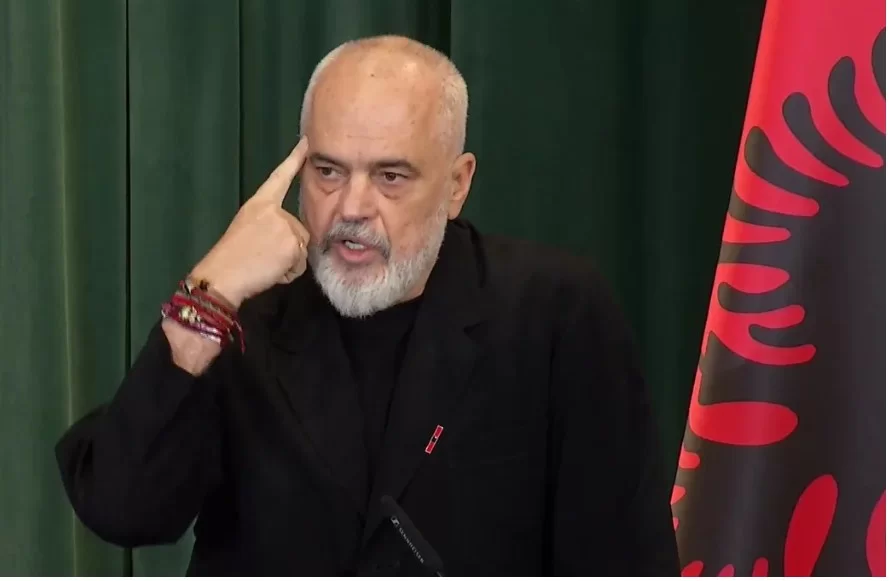
Prime Minister Edi Rama, during an interview with the Italian media outlet “Vanity Fair”, spoke again about the Zvërnec and Sazan projects, considering them vital for our country.
Rama again emphasized that he would be against the project if it negatively impacted the environment, saying that only luxury tourism can save the country and its nature from the destructive impact of mass tourism.
The Prime Minister also focused on the national protests taking place in our country, while not hesitating to accuse Iran of being behind their incitement.
“There is certainly an Iranian-instigated component among the protesters. It is no secret that Albania is under pressure: Tehran has previously attempted to carry out a cyberattack on our security systems years ago. They failed,” he said.
As for leaving the post of Prime Minister, Rama said that he would do so after our country’s integration into the European Union. It is worth noting that the Prime Minister and the Albanian government have set the year 2030 for EU integration.
Focusing on integration, the head of government underlined that Albania still has work to do, but he again expressed optimism.
Prime Minister Rama’s full interview for “Vanity Fair”:
Prime Minister Rama: The walls of this office are moving
Journalist: In what sense?
Rama: When I first won the election, in 2013, I asked Tony Blair for advice. He replied: “Governing a country is like standing in front of a fresco. You have to keep your distance; if you get too close, you lose the big picture.” The problem is that, often, it is the fresco itself that comes towards you. The walls narrow until you feel like you are in a cell from which you cannot escape.
Journalist: The vital space of the Prime Minister of Albania Edi Rama, for all Edi, 62 years old, on July 4, two meters tall, is squeezed on the one hand by the judiciary, whose corruption investigations have reached his deputy Belinda Balluku; on the other, by the political opposition of Sali Berisha, the leader of the right and former prime minister, who does not miss an opportunity to accuse him of having transformed the country into a “narco-state”. Then there are the deadlines that must be respected to adapt to standards, in the hope of EU membership in 2027, the main objective of this fourth mandate of his.
Since May 23, thousands of people have poured into the streets of Tirana to protest against the granting of the island of Sazan and the coast of Vlora to Jared Kushner and Ivanka Trump, who intend to build luxury resorts in untouched areas inhabited by pelicans and flamingos.
Flamingos have become the symbol of a movement, the “flamingo revolution,” which continues with slogans like “Albania is not for sale” and which has quickly transformed dissatisfaction with the environmental issue into a broader dissatisfaction with the establishment.
Against Rama in the first place, whose resignation is being demanded both at home and abroad. Even the American Democratic Senator Bernie Sanders, in a post, has expressed his opposition to the Albanian government’s submission to the “global oligarchy.”
Surrounded by more than one front, the former national team basketball player and prominent artist, former mayor of Tirana and leader of the Socialist Party, builds his defense by questioning the starting point.
Prime Minister Rama: If it were true that we are selling our land to oligarchs ready to destroy it with mega-constructions, I would be the first to feel disgusted. But is it true?
Journalist: You tell us.
Prime Minister Rama: It is a narrative built on half-truths that, passing from mouth to mouth, from post to post, have transformed into a giant lie.
Let’s start with the half-truths. There are two sites: the first, the coast of Vlora was private property and was sold to investors.
There are those who say the sale was not legal and that Donald Trump’s son-in-law, Jared Kushner, is now under investigation.
The former owner was under investigation for another matter. The transaction is now on hold until the legal ownership of the land is clarified, which in Albania remains a delicate issue since the fall of the regime and the redistribution of property titles. Once ownership is clarified, the amount will be paid to the rightful owner.
Journalist: What about the second site?
Prime Minister Rama: It is the island of Sazan, which belongs to the state. And there is no intention to sell it. We are negotiating a partnership. Then environmental analyses will begin to ensure that nature is protected.
Journalist: You are accused of changing the environmental protection law just before negotiations with Kushner began, precisely to pave the way for him.
Prime Minister Rama: We have adapted our legislation to European standards that provide for different levels of protection. There are untouchable areas, such as the Vjosa River Delta, and areas where construction can be done, always respecting EU standards.
Journalist: Are the protesters demanding a complete abandonment of the project?
Prime Minister Rama: The curious thing is that there is still no concrete project. There is an idea, a dream that some of the best architects and environmental engineers in the world are working on. I’m talking about people like Kengo Kuma, Jean Nouvel, Dong Yugan. When the project is ready, we will proudly make it public and open discussions with environmentalists.
Journalist: However, the fact remains that any intervention will affect the environment more than the absence of intervention.
Prime Minister Rama: In this case, however, the pact foresees that there will be more green areas in the end than at the beginning. Doubts arise from the assumption that economic development and environmental protection are necessarily enemies. This is a mistake. Only luxury tourism can save the country and its nature from the destructive impact of mass tourism. But many will not listen because they are focused on other things.
Journalist: In what?
Prime Minister Rama: On the name of the investor: Kushner, Ivanka Trump’s husband. But when the meetings started, the US president was Biden and it was not known whether Donald Trump would end up in the White House or in prison. I think it is wrong to use Albania to fight political battles in other countries.
Journalist: Who are you referring to?
Prime Minister Rama: The list is long. There is certainly an Iranian-instigated component among the protesters. It is no secret that Albania is under pressure: Tehran has previously attempted to carry out a cyberattack on our security systems years ago. They failed. And now they are trying again by building an anti-Israel narrative according to which this project is a favor to Netanyahu. Madness. Then there are also tourism competitors, who of course oppose our development. There is no shortage of my political opponents either. The rest are good people who truly believe in it. To them I say: wait until you see the project and then judge.
Journalist: Meanwhile, they’re asking him to leave. Do you ever think about that?
Prime Minister Rama: As long as I feel the fire of passion, I will stay. If Albania were truly accepted into the EU, the first meeting as a member state would be the best opportunity to resign.
Journalist: Are you still willing to give up your veto right?
Prime Minister Rama: Absolutely. Europe should be like a family table where there is hierarchy. I’m not talking about different categories of citizenship, but the EU cannot function with the full consensus of everyone.
Journalist: How much does it cost the EU to accept you?
Prime Minister Rama: A recent study by the European Parliament says that, in financial terms, leaving the Western Balkans out is more costly than bringing them in.
Journalist: Is there also a political opportunity to remove that area from Moscow’s influence?
Prime Minister Rama: Not for Albania, which has not had official relations with the Kremlin since 1960: no state visit since then. In our country, Putin’s popularity does not exceed 2.7 percent. The same cannot be said for countries like Serbia, which see Russia as a potential ally.
Journalist: However, you have said several times that we need to talk to Putin to end the war in Ukraine.
Prime Minister Rama: Yes, it would be appropriate to open a negotiating table, because Russia is there and will remain. And Europe has a diplomatic role, even in very fierce conflicts like the one between Israel and Hamas: there is blood, but there is also dialogue.
Journalist: You have always stated that Albania is a friend of Israel. How do you see Netanyahu’s government and its actions in Palestine today? According to the latest data, there are over 20,000 children killed.
Prime Minister Rama: After the fall of the regime, Albania was isolated, without allies in the East or the West. We have suffered a lot and now that we have good relations with Israel, with the Gulf countries, with Turkey, we cannot allow a “barricade” policy. I consider Hamas to be absolute evil. Do I agree with everything the Israeli right does? No. Am I in a position to keep anyone’s morale up? No.
Journalist: Does the same logic apply to immigrant reception centers, despite the fact that you yourself come from an immigration background?
Prime Minister Rama: I think this is that we should not ask questions when the Italian government asks us for help, because you did not ask questions when we needed it.
Journalist: With Giorgia Meloni, you come from two very distant ideological worlds.
Prime Minister Rama: It doesn’t seem to me that she is the heir of Mussolini. It seems to me more like the heir of the Pentapartite. And I don’t believe that different ideologies can hinder cooperation.
Journalist: Was there a time when ideology was everything to you?
Prime Minister Rama: I’ll just tell you this: I learned Italian from my grandmother, who was from Venice. Then I left it when I became a Marxist and considered your language the language of fascists. Later I returned, realizing that I couldn’t be that stupid.
Journalist: What period are we talking about?
Prime Minister Rama: My adolescence. I was a rebellious boy, not in the sense that I ran away from home. I was rebellious in my mind. My mother used to tell me: “That language will take you to hell.”
Journalist: Was he right?
Prime Minister Rama: I almost went to the morgue. During a period before the financial collapse, someone ambushed me. Their faces were covered and they had iron bars in their hands. They left me on the street, almost dead. That episode could have changed my life.
Journalist: You mean?
Prime Minister Rama: I had decided to stay in Paris, where I had gone on a scholarship as a painter. I painted, exhibited, believed in the young French philosophers. I behaved like an engaged intellectual.
Journalist: Then?
Prime Minister Rama: My father, to whom I was very close, died. I returned to Albania and on the same day of the funeral, the then Prime Minister, Fatos Nano, offered me the position of Minister of Culture. I had previously refused, but at the time I felt guilty because I was living abroad. I accepted. A little later, his spokesman came to my house and said: “I need your CV”. I took a piece of paper and wrote: “I am Edi Rama, born on July 4, and this should be enough”.
Journalist: Do you regret coming back?
Prime Minister Rama: When I returned to Paris to get my things, I cried the whole way. After that, never again. I had difficult moments, but I lived intensely. My life is like a movie. I have nothing else to ask God for.
Journalist: Are you a believer?
Prime Minister Rama: I am Catholic, but I do not attend church. I was very close to Pope Francis: he often told me that he prayed for me and for Albania. I was at a meeting with my wife, Linda, and our newborn son, Zaho. Our family is multi-religious: the wife is Muslim, the children from her previous marriages are Orthodox. I asked the Pope: “And what should be done with the latter?” He said: “I will decide for myself.”
Journalist: Do you like Papa Leone too?
Prime Minister Rama: I have only met him once. He is different from his predecessor: much less open and extroverted. However, it seems to me that he has a strong character and good will.
Journalist: Do you think he will be able to put a limit on conflicts?
Prime Minister Rama: I don’t believe that stopping wars is part of a Pope’s capabilities. His voice serves to show people another “garden” to look at: like culture or art.
Journalist: What space does art have in your life today?
Prime Minister Rama: I draw whenever I can, even in the office.
Journalist: But in front of your desk, however, there are not only your paintings hanging, but a drawing by Zaho, with an inscription: “Dad, I’m proud of you.”
Prime Minister Rama: He hasn’t known anything better. I’m not the father I would like to be: work doesn’t allow me.
Journalist: Are you the man you would like to be?
Prime Minister Rama: People say I win the elections because I don’t have a credible opposition. They don’t know that the most stubborn opposition is at home. Linda always challenges me to think in a different, more morally correct way. She is an economist and human rights activist. She doesn’t make compromises that will keep you awake at night.
Journalist: What are you losing sleep over lately?
Prime Minister Rama: I often lose it because I fail to keep the right distance, as Tony Blair advised me. Sometimes I feel suffocated. Other times I feel lonely. I know that I have loyal people around me, I know that I have my family, but when I have to make certain decisions, I have no one else. Because, no matter what, you are the one who makes those decisions. And you are the one who pays the consequences.