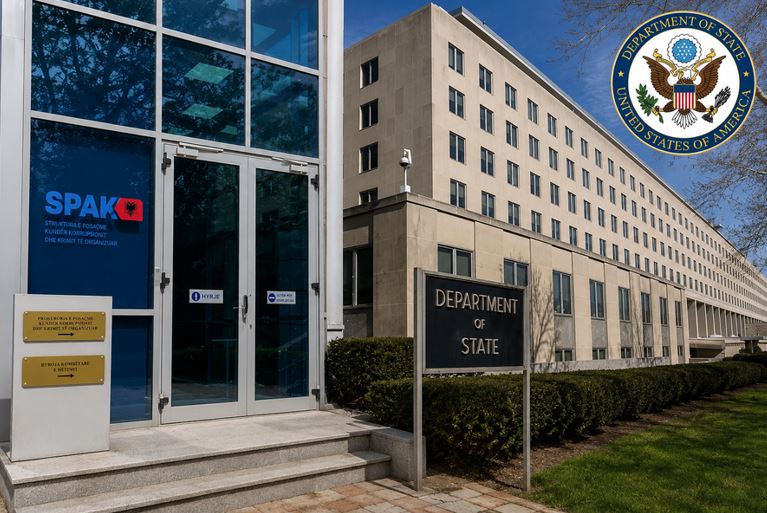
The United States Department of State has issued a strong alarm and a very clear message for Albanian justice and politics: the fight against corruption requires even stronger blows and shackles at the highest levels. Through the latest report of the Overseas Security Advisory Council (OSAC), at the State Department, part of which the newspaper “SOT” published yesterday, Washington has made a detailed scan of the situation in the country, bringing to light the biggest wound that is eroding the rule of law: the impunity of “VIP” officials.
Impunity of “VIP” officials and SPAK strikes
Despite the work and achievements of the Special Structure Against Corruption and Organized Crime (SPAK) since its establishment in 2019, the OSAC report highlights that the results are still not sufficient to end the culture of impunity. “Impunity remains a serious problem.
Since the establishment of SPAK in 2019, the arrest and prosecution of officials who commit abuses has increased. However, many officials, politicians, judges and people with powerful business interests continue to evade prosecution,” the report states. The report further acknowledges that the establishment of SPAK has brought about a significant increase in investigations and prosecutions for abuses at high levels, but the schemes that political castes and powerful people follow to escape accountability remain a major obstacle. Washington insists that the action of justice does not stop at secondary levels, but hits corruption directly in the head.
How is the investment climate and economy being destroyed?
But one of the most critical points of the US Department of State (DASH) report is related to the severe blow that rampant corruption deals to the national economy and foreign investments. According to OSAC, businesses and foreign investors face a stifling environment where fair competition and transparency are lacking. The main factors that are destroying the business climate in Albania include:
• Capillary corruption: Present in the judicial system, government, public procurement (irregular tenders) and the media.
• Lack of transparency: Closed procedures and the lack of open and equal competition.
• Informal economy: A large part of the market operates outside the legal framework, harming honest businesses.
• Poor contract enforcement: Legal uncertainty makes foreign investors skeptical about bringing their capital to Albania.
These factors, according to the US, not only discourage new foreign investments, but also seriously damage the trust of entrepreneurs in state institutions.
Obstacles to law enforcement and further steps
Meanwhile, according to the report’s findings, corruption continues to be a major obstacle to the work of law enforcement institutions themselves. OSAC notes that there are serious obstacles to the exchange of information between state institutions, insufficient coordination between different agencies, as well as a judicial system that is still in the process of development.
However, the State Department’s final message is clear: the fight against corruption is not over. Punishing senior political figures and cleaning up public tenders remain key conditions for guaranteeing the rule of law and restoring trust in Albania.
EXCERPT FROM THE DASH REPORT
Law Enforcement
“Corruption and obstacles to information sharing among government agencies, insufficient coordination within agencies, and a still-developing judicial system continue to hamper law enforcement efforts in Albania. Albania’s Special Structure Against Corruption and Organized Crime (SPAK), which was established in 2019, prosecutes cases involving terrorism, high-level corruption, and organized crime.
SPAK prosecutes complex cases and cooperates directly with key international law enforcement and prosecution entities. District prosecutors’ offices throughout the country prosecute the remaining cases that do not fall under SPAK’s limited jurisdiction. SPAK and other law enforcement services in Albania cooperate extensively with INTERPOL and other international law enforcement bodies.
Police Response
Police have a visible presence throughout Tirana and other major cities in Albania, although their response is often delayed due to limited resources and manpower. Police tend to respond more quickly to reports from members of the international community. However, law enforcement’s ability to protect and assist travelers is limited in some areas, particularly in remote regions. Corruption and lack of resources within the police pose ongoing challenges.
Rule of Law, Arbitrary Detention, Official Harassment, Corruption, and Transparency
The U.S. Department of State has not included a “D” Indicator of the Risk of Unfair Detention in the Travel Notice for Albania. If you are arrested or detained, ask police or prison officials to notify the U.S. Embassy immediately. The law and constitution prohibit arbitrary arrest and detention and provide for the right of every person to challenge the legality of his or her arrest or detention in court.
The Albanian government generally respects these prohibitions, but there have been cases where police have detained individuals for questioning for long periods of time without formally arresting them. Albania has a sound legal framework to combat corruption and prevent conflicts of interest of public officials and politicians, including their family members. However, foreign investors cite corruption, including in the judiciary, government, public procurement, and the media, a lack of transparency and competition, a large informal economy, and weak contract enforcement as some of the biggest problems hindering the business environment in Albania. Impunity remains a serious problem.
With the creation of SPAK in 2019, the arrest and prosecution of officials who commit abuses has increased, however many officials, politicians, judges, and persons with powerful business interests are still able to avoid prosecution. Corruption continues to be a serious problem in detention centers, particularly in relation to access to work and special release programs,” the US Department of State (DASH) report states, among other things.