Are Albania’s most protected areas turning into its most vulnerable spaces?
Nature protection is openly clashing with claims for economic development, turning the debate over protected areas into one of Albania’s most serious tests towards the European Union.
While the government claims progress in EU accession negotiations, the debate over the fate of protected areas has become a key test of the country’s political credibility. The contested February 2024 amendments to the Protected Areas have raised red flags in Brussels.
In a strong reaction, the European Parliament recently called on the Albanian authorities through a resolution to “immediately impose a moratorium on all new permits and construction works within protected areas, until the 2024 amendments are repealed.”
Meanwhile, a spokesperson for the European Commission, in response to Faktoje.al’s interest, reminds the Albanian government of its obligations to conclude negotiations on Chapter 27, and confirms that the Commission is closely monitoring the situation.
“The closing criteria for Chapter 27 were set in September 2025. They require approximation with EU legislation (EU acquis) on nature protection, repeal of incompatible provisions adopted through amendments to the law on protected areas, as well as repeal of the 2015 legislation on strategic investments,” a European Commission spokesperson told Faktoje.al in a written response.

Coping
However, in the face of concerns from Brussels, the authorities in Tirana say that the critics’ claims are not based on legal facts. In an official response to Faktoje.al, the Media and Information Agency (MIA) downplays the gravity of these concerns, and on the other hand says that the law in question will nevertheless comply 100% with the directive as part of the calendar agreed with the European Commission.
“The resolutions of the European Parliament are not binding on any member or non-member state, while those who are seeking the repeal of the 2024 amendments have not provided any evidence that they conflict with the European directive ,” the Media and Information Agency said in its response.
Opposition
But Jorida Tabaku, opposition MP and Chairwoman of the National Integration Council, has a different approach and is quite critical.
“It is true that the EP resolution is not directly binding on the Albanian parliament, but it is suggestive at the moment when decisions are made by the European Parliament for Albania. So, although not directly, it makes its cycle and becomes binding for our country ,” argues Ms. Tabaku.

Legal framework and DCMs over the years
The 2024 amendments to the Law on Protected Areas were not an isolated incident, but a continuation of a 10-year government policy that sees the territory of protected areas as a resource for tourism development. This path began with the adoption of the Law on Strategic Investments a decade ago (with an initial 3-year deadline, but repeatedly postponed until the end of this year) with the government’s aim to strengthen elite tourism on the coast, followed by several VKMs affecting the boundaries of protected areas.
Environmental expert Olsi Nika attacks three decisions, the one on National Parks (Category II) in 2022 that concluded with a general review of the boundaries of all National Parks in Albania. He says that entire areas within protected areas were stripped of their protection regime.
Another decision, as Mr. Nika says, classified as Managed Nature Reserves those protected areas that previously enjoyed the status of Strict Nature Reserve (Category I), followed by one of the most debated decisions, that for the Poro Nartë Pine Protected Landscape of 2024. The environmental expert says that this decision affects one of the most important wetlands in the Mediterranean and the main migration route of birds (including flamingos and pelicans).
“It revises the boundaries of the Vjosa-Narta and Pishë Poro Protected Landscape, and its internal zoning,” argues expert Nika.
“We have challenged all three of these decisions legally by addressing them to the Administrative Court of Appeal. The processes are still ongoing. When the processes started to get interesting, the government sensed the danger and used the parliament to notarize the latest act: the Law on Protected Areas. This law legitimizes intensive urban developments within protected areas,” Olsi Nika, Executive Director of “EcoAlbania”, tells Faktoje.al.


The official position of the authorities
But on the other hand, in a special written explanatory response to Faktoje.al, the Media Information Agency argued these decisions “with the need to modernize the network of protected areas according to EU and IUCN (International Union for Conservation of Nature) standards, reflecting the latest scientific knowledge and reality on the ground.”
For the Albanian authorities – “in practice, Albanian protected areas were created at different times, with criteria that were not always the same and with borders that in many cases did not reflect natural habitats or ecological units.”
The response explains that “For this reason, a review process was carried out, where: the protection categories were harmonized with the international classification of the IUCN (International Union for Conservation of Nature), the boundaries were corrected to better follow ecological and not only administrative boundaries, overlaps and inaccuracies created over the years were eliminated, and new areas with high natural values were included, bringing these areas to 22%. “
These changes, according to officials, were the products of a national study conducted by the National Association of Parks of Albania with the financial support of the National Agency for Protected Areas and the Ministry of Tourism and Environment.
Positions on the changes to the Law on Protected Areas

The initial draft of a group of SP deputies, based on the requests of several municipalities, was consulted, according to experts, with interest groups, but they regretfully say that in February 2024, the parliament approved the draft that mostly reflected the interventions of the Government and the Ministry of Tourism, without consulting these groups.
Lawmakers from the ruling majority at the time defended the idea that the law would not allow “uncritical” or massive construction, but only ecological high-end tourism structures (5-star resorts), arguing that elite tourism brings in large revenues for the state and does not harm the environment as much as mass popular tourism.
But the arguments of the opposition and environmental organizations are completely opposite, calling it an ominous law for the environment, national ecosystems, and biodiversity.
Jorida Tabaku highlights some of the problems with the Law on Protected Areas, while also arguing for the idea of repealing the Law on Strategic Investments, a request from the European Commission. Both of these laws, she says, are intertwined with each other to the detriment of the environment and the free market.
“The 2024 amendments to the Law on Protected Areas pave the way for a certain percentage of construction (20% to 40%) in these areas. The law centralizes powers, removes some responsibilities from local government and transfers them to the National Territorial Council (NTC).
“Also, the Law on Strategic Investments should be annulled because it allocates public assets without competition and free competition (gives favors and removes taxes) thereby violating the free market. If until yesterday strategic investments were not allowed in protected areas, now they are allowed,” says Jorida Tabaku.
And while Prime Minister Edi Rama has pledged in Brussels that the Strategic Investment Law will be repealed, having, as he put it, accomplished its mission, the debate over amendments to the Law on Protected Areas looks set to continue for a long time. Environmental experts continue to be highly critical.
“After the 2024 amendments, the law, despite being titled ‘The Law on Protected Areas’, is actually the ‘Law on Waste Areas’. Only those areas that have remained outside the current interest of any developer or strategic investor are effectively protected,” argues Olsi Nika, an environmental expert.
But in the explanatory arguments for Faktoje.al, the Media and Information Agency states that “The 2024 changes do not aim at uncontrolled liberalization of construction, but at creating a clearer legal framework for the development of activities that are considered compatible with nature conservation objectives,” citing the fact that “the law does not create an automatic right to build in protected areas, as each project must pass mandatory filters such as the Environmental Impact Assessment procedure as appropriate or obtaining authorizations provided for in the legislation. The concept is not – ‘development to the detriment of nature’, – but controlled and conditional development, similar to the models that exist in many member states of the European Union. These changes do not exclude any of the procedural guarantees required by European law,” the response of the Media and Information Agency further states.
controversy
But for one of the voices defending tourism, nature and cultural heritage, Auron Tare, nothing has been accidental or a flow within normality:
“All these custom-made laws show that the government over the years has adopted a legal framework for certain purposes. Especially ‘Albania Files’ shows that there is a vision of the Prime Minister, determined to advance these projects without public consultation and without fulfilling legal obligations. All of this has been overlooked in the most arrogant way,” Auron Tare, Researcher / Member of the UNESCO Scientific Council for Underwater Heritage, tells Faktoje.al.
The judicial path
In the face of the political and technical debate between Tirana and Brussels, environmentalists have followed a different path than the Court, attacking the 2024 amendments to the Protected Areas Law in the Constitutional Court.
The Constitutional Court, in 2025, through a 4-4 vote, failed to reach a decision on the request of opposition MPs, supported by environmental organizations, to suspend the law, while it made a 5-3 decision to dismiss the request for the unconstitutionality of the law.
The AOS organization and EcoAlbania have sent the Constitutional Court’s decision regarding the Protected Areas law to the European Court of Human Rights in Strasbourg.
Meanwhile, EcoAlbania has sent a complaint about projects in the Pishë-Poro Narta area (including that of Zvërnec) and legal changes to the Bern Convention.
These projects are already in the focus of Brussels. In a written response from a European Commission spokesperson to Faktoje.al, it is stated that:
“The European Commission is closely monitoring the situation, as well as ensuring continuous contact with the Albanian authorities and civil society. In the case of the project in the Pishë Poro–Nartë area – as is the case for all ongoing projects in Albania, it will have to comply with the criteria set out in the framework of the environment chapter (27) of the accession process. This chapter is currently open ,” the European Commission argues for Faktoje.al through a spokesperson.
But the authorities in Tirana continue to reiterate that the legislation will be adapted within the framework of negotiations with the EU, but without providing concrete details on how, although on the other hand they defend the attacked changes to the Law on Protected Areas.
The Media and Information Agency, responding to the interest of Faktoje.al, stated that the Law on Protected Areas will comply 100% with the directive as part of the calendar approved with the European Commission. “In the end, we will see who was right and who was less right ,” MIA’s response states.
Situation on the ground and monitoring of the areas

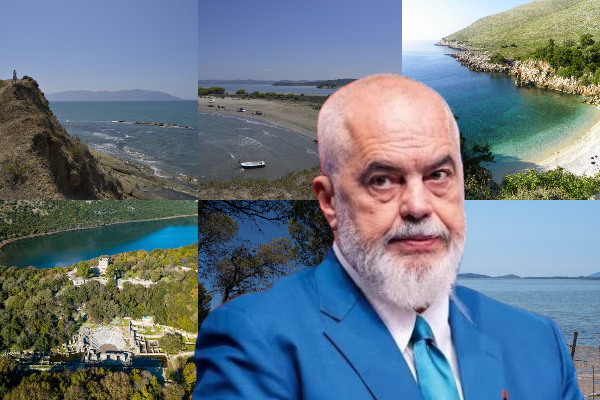
But environmental experts currently think the end seems imminent, listing several protected areas affected by the law, in which construction projects have begun or are pending, such as:
• The Poro Nartë Pine Area,
• Divjakë-Karavasta National Park
• Karaburun Natural Park,
• Butrint National Park (Monastery Bay / Aramerë)
• Complex ligatinor Kune –Vain –Tale
• In the Rana e Hedhun area, a third category natural monument.
• In the Bunë Velipojë Zone, a managed nature reserve.
Environmental activists argue that these areas are witnessing a mix of construction that includes residential complexes, structures for mooring yachts and marine vehicles, and multi-story hotels that replace traditional or environmental structures.
“In those areas that have been affected, the environmental damage is extraordinary because they can no longer be called protected territories, but have turned into urban areas. In the Bay of Manastir you see only construction, no greenery. The same thing in the Karaburun Nature Reserve or with projects in the Butrint National Park. There is practically no legal protection anymore,” Taulant Bino, Ornithologist / Director of the Albanian Ornithological Society (AOS), tells Faktoje.al.
Environmental organizations argue that the changes to the Law on Protected Areas have not simply created a local debate, but have placed the Albanian state in strong positions of confrontation with the Council of Europe (Berne Convention), the European Commission, and the networks of global environmental conventions.
“There have been two parallel paths: on the one hand, the official path with the EU, where ‘yes’ was said to every request; on the other, the path followed for certain interests, goals and plans. These two paths do not merge. Now that there have been reactions, the EU is realizing that what was promised on paper and what is being done on the ground are two completely opposite things,” continues Auron Tare.
But on the other hand, internal pressure is also quite high. For almost two months, a broad civic resistance that began in opposition to the construction of a luxury resort in Zvërnec, “under the guise” of the Flamingo Revolution, has been clearly articulated in the preservation of the environment, natural habitats and ecosystems.
“Every move by the government will be in the ‘sieve’ of the EU. If the government continues against protected areas, then it says ‘goodbye’ to the European integration process. The civil society protest has given very clear messages, such as: Repeal of the Law on Strategic Investments, repeal of the damaging amendments to the Law on Protected Areas, transparency on decision-making in the elite tourism sector and the cancellation of the Zvërnec project and sister projects”, continues Taulant Bino.
The debate remains open.
The debate on the Law on Protected Areas has now gone beyond a local environmental discussion, becoming one of the most difficult tests of Chapter 27 and a key test for the balance between economic development and Albania’s integration obligations. While state institutions insist that the new framework will be fully aligned with EU directives according to the negotiation calendar, the real test remains its implementation on the ground.
At this crossroads, the government’s commitment to legal harmonization is facing pressure from Brussels and that of the citizen reaction at home. In the end, the success or failure of this reform will not be measured by political declarations or negotiation calendars, but by what will actually remain protected in Albania’s territory and ecosystems.
/ Mimoza Picari – Faktoje.al