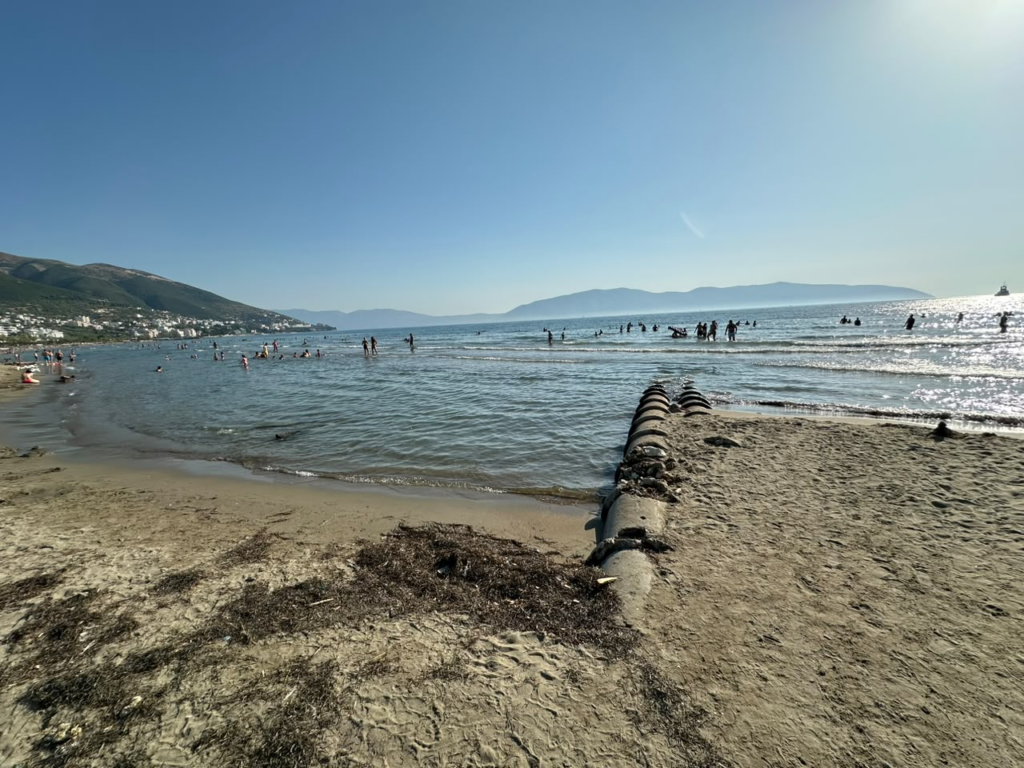
On the afternoon of July 29, the wastewater discharge points near the New Beach in Vlora were indistinguishable to the naked eye from the Lungomare promenade, thus hiding a problem that has been recurring for years.
To find them you had to go down to the beach and walk along the seashore.
Most of the public beach is concentrated in this part of Vlora.
A tent with two sun loungers there costs 700 lek, significantly cheaper than in areas beyond Cold Water.
That day, the beach was packed with families, seniors, locals, and foreign tourists.
After a long walk in the sun, I decided to ask a waiter at one of the beach bars in the area.
“Here are the pipes, at the beach of the former Navy School. They do the dumping early in the morning, before the beach starts. They’re terrible,” said the waiter, pointing in the direction.
Prices
While we were talking, two foreign tourists approached to ask about the price of the tents. “1500 lekë,” he replied curtly.
The private beach where they were was just a few meters from the pipelines.
The tubes were closer than I expected. They emerged from the sand and stretched out into the sea, while vacationers bathed quite calmly towards them.
The presence of the pipes was warned by the unpleasant odor felt in the area.


There were two cylindrical tubes, adjacent to each other, partially covered by sand and extending towards the sea.
They weren’t immediately noticeable, but to anyone on the beach near them they were completely recognizable.
However, the phone I was using to take photos and videos seemed to attract more attention than the tubes themselves.
The beach day continued normally.
Everyone swam near the line where the pipes entered the sea.
At the new beach, I also met a Finnish citizen, who said he had been living in Vlora for about a year.
The concern he raised was not just related to the waters.
According to him, every week he collected about 200 plastic packages from the sea.
Regarding Albania’s approach to the environment, he expressed skepticism, arguing that EU membership would be premature as long as these issues remain unresolved.
Old beach
From the New Beach I headed towards the Old Beach.
Here the panorama changed. Behind the port, as far as the eye could see, there was sand, beach and umbrellas. On the port side, some vacationers were lying on the sand without umbrellas, while further on, organized beaches continued uninterrupted until they reached the Soda Forest.
The sand was a darker color and the whole area reminded me of the beaches of Durrës. The walk promised to be long: from the port area, through the Cabin Beach and the Pioneer Camp, to the large canal near the entrance to the Soda Forest.


A pipe emerged from under a concrete slab and continued towards the sea, creating a line of water towards the shore. Next to it, tourists bathed undisturbed.
Despite this, the atmosphere around 6:00 PM remained unchanged; the beach was bustling with families and tourists enjoying the last rays of the sun, in silent contrast to the problems that lay right under their noses.
The new and old beach, for many locals, were not only cheaper, but also closer.
There was also the option of not paying a single lek: to bring your own tent or simply lie on the sand, as some foreign tourists did.
Channel
On the way, as I continued walking along the coast towards Soda Forest to identify other discharge points, I stopped and asked an elderly man.

“The large canal is at the entrance to the Soda Forest. I’ll accompany you. Everything flows there,” he told me.
This time we no longer continued along the seashore, but towards the forest.
It wasn’t necessary to reach the canal to realize we were approaching it.
The heavy wind could be felt many meters ahead. The closer you got, the stronger it became.
At the end of the road, a wide, open channel appeared that ended directly in the sea. It was no longer a pipe partially hidden in the sand, but a visible stream that reached all the way to the shoreline.
The smell was much heavier than near the pipes I had seen earlier and covered a wide area around.
An old problem
According to monitoring data for 2023, included in the KLSH audit, the Navy School, Cabin Beach, and Pioneer Camp in Vlora resulted in “bad” bathing water quality.
Among them, the Navy School was also ranked among the ten most polluted beaches in Albania.
The problem at the Navy School predates a single season. The SAI found that this point had been rated “poor” for five consecutive years. According to the regulatory framework cited in the audit, in such a case the public should have been notified and a permanent ban on bathing should have been imposed; the SAI found that these measures had not been taken.
When auditors verified the site in July 2024, the Cabin Beach, Pioneer Camp, and Navy School also lacked signage that should have warned vacationers about the “bad” water quality found in the 2023 monitoring. The signage is still missing.
26 points of “bad” quality
The latest data from the European Environment Agency, published in June 2026 and referring to the 2025 season, show a deterioration in the classification of Albanian coastal waters. From 6 points of poor quality in 2022, there have been 26 points in 2025.
With only 15.9% of coastal waters classified as “excellent”, Albania had the lowest percentage in the EEA comparison for 2025. The EU average was 88%; Estonia and Finland, the other two countries with the lowest percentages, recorded 40% and 55.1% respectively.

At the national level, including inland waters, 28 of the 119 reported points, or 23.5%, were classified as having “bad” quality.
The classification is based on the concentration of Escherichia coli and intestinal enterococci, the two microbiological parameters defined by the European Bathing Water Directive.
The HSE explains that these bacteria can cause disease and that they are usually associated with untreated wastewater that ends up in bathing water.
Although all 119 sites were monitored, for the 2025 season none had met all the monitoring calendar requirements set out in the EEA Directive.
Polluted waters
According to the 2025 Annual Report of the Water Regulatory Authority, the Vlora WWTP was licensed to discharge wastewater, but not to treat it. The WRA explains that the Vlora and Orikum plants did not meet the requirements for this category of license due to the lack of environmental permits. The Albanian Supreme Audit Institution (KSAI) has also found that the Vlora plant was operating without an environmental permit.
According to the KLSH audit, the plant only performed mechanical, or primary, treatment, and not secondary treatment in accordance with legal requirements. The waters that came out of it were only about 35% treated. They were then combined with untreated waters that came from the hydrovor and ended up in the sea.
In early 2023, the then Minister of Tourism and Environment, Mirela Kumbaro, declared that the goal was to “zero problematic bathing waters” and move towards the “blue flag” standard, a promise that Faktoje classified as unfulfilled in October 2025.
The summer continues
In the New Beach and the Old Beach, water pollution is not visible to the naked eye. On the afternoon of July 29, the beach continued its usual rhythm… Along with the problems. /Faktoje.al