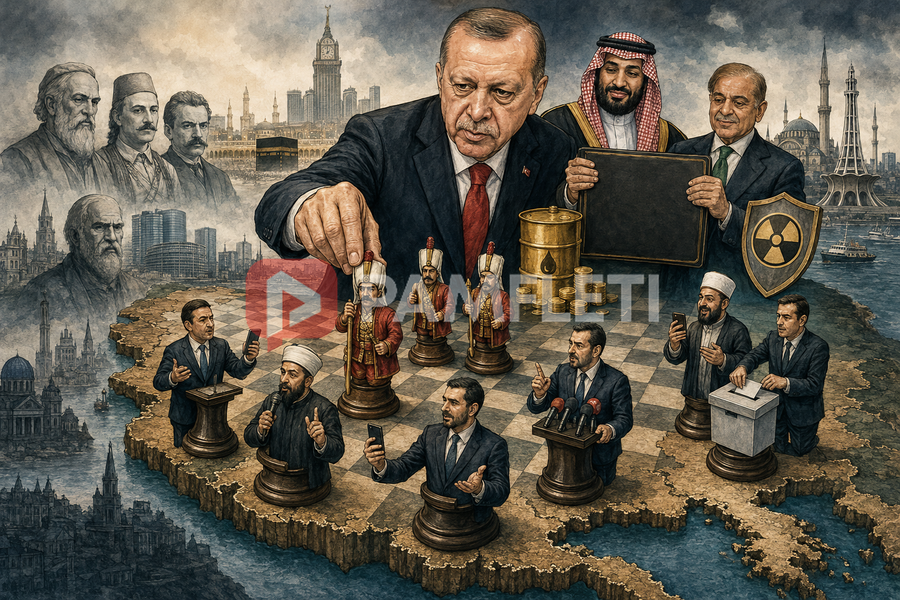
The “Pact of Mecca” and the new Janissaries: Ankara seeks its Ottoman party in the Balkans…
Turkey’s alliance with Saudi Arabia and Pakistan is being sold as a shield for Albanians, while neo-Ottoman networks prepare the political terrain by attacking national figures and Western orientation.
In recent days, there has been great excitement in some Albanian circles about the mutual defense pact between Turkey, Saudi Arabia, and Pakistan.
Turkey’s Foreign Minister, Hakan Fidan, not the Defense Minister, compared the mechanism of this pact to NATO’s Article 5. If one country is attacked, the other two countries must come to its aid.
International media have portrayed the agreement as uniting Turkey, one of the region’s leading military powers, with Saudi Arabia, one of the world’s richest economies, and Pakistan, a nuclear power.
Pandeli Majko, a former prime minister and several-time minister, considered the agreement an important development for the Balkans and the world. Meanwhile, Erdogan’s media supporters in Albania are trying to give an Albanian patriotic color to an agreement concluded between three Asian states.
According to them, the Turkish-Saudi-Pakistani pact constitutes a strong weapon against Serbia and a guarantee for the protection of Albanians.
This thesis did not emerge by chance from “patriotic thinkers.” It is nurtured by the center that supplies the neo-Ottoman discourse in the Albanian space, using patriotism and the fight against enemies as ideological weapons.
Ankara, Riyadh, and Islamabad have dubbed the agreement the “Mecca Pact.” The name itself creates the impression of an agreement that also aims to protect Islam’s holy sites.
This terminology recalls the discourse used by the Ottoman Empire during its rule over large parts of the Middle East. For this reason, some Arab actors may view with concern the return of a vocabulary that reminds them of Ottoman domination. Arab peoples and states were separated from the Ottoman Empire through political and military processes that culminated in the First World War.
Ankara knows that the return of neo-Ottoman discourse creates problems in the Middle East, where the historical memory of Ottoman rule remains complicated. However, for Erdogan’s Turkey, the return of an imperial agenda is becoming a political instrument.
Erdogan seeks a cause that unites his supporters, shifts attention away from domestic problems, and gives Turkey a role beyond its borders. The Iranian regime has used a similar mechanism for years, linking domestic legitimacy to regional conflicts and the fight against external enemies.
Beyond the propaganda that reaches us, Turkey is in a problematic situation, like many countries where the government controls a large part of the public space.
Politically, Turkey remains a divided and fragmented country. The imprisonment of opposition figures and the use of state institutions to maintain power have weakened political stability.
The economy is also facing problems. Economic growth fell to 2.5 percent in the first quarter of 2026, while industry contracted by 0.8 percent. Inflation, the depreciation of the lira and the weakening of purchasing power continue to weigh on Turkish households. Exports and imports have not fallen in absolute terms during 2025, but the economic pace and the contribution of foreign trade to growth have weakened.
Signs of a slowdown have begun to appear, which remains worrying for a powerful country like Turkey, with large budgetary and military expenditures.
An empire does not fall immediately, but once it begins to fall, the process of rising again becomes difficult. A small country like Albania can experience both the fall and the rise more quickly.
Turkey faces another problem: large ethnic and cultural communities live on its territory that the state has not fully integrated into a common identity.
The modern Turkish Republic, founded by Mustafa Kemal Ataturk, was built on a nationalist, secular project inspired by European models of the nation-state.
Turkey is home to a large Kurdish population. Kurds are concentrated mainly in the east and southeast, but also live in major cities throughout the country. Estimates of their number vary, but some put them as high as 20 or 25 million.
Turkey is also home to Arabs, Laz, Georgians, and other communities of Caucasian origin. Armenians, Greeks, Roma, Jews, Albanians, Bosnians, and Bulgarians also live there.
There is no official statistic proving that five million Albanians with an active ethnic identity live in Turkey. Such figures circulate in the media and in diaspora organizations, but they also include citizens of partial Albanian descent, assimilated for generations.
The Turkish Republic has not always recognized these communities as separate identities. It has attempted to integrate them within the official Turkish identity, with the aim of preserving the cohesion of the nation-state.
This cohesion remained relatively strong during the secular and republican period, although the Kurdish question remained the main internal problem. Turkey of that time aimed for a more Western orientation and did not place the revival of neo-Ottomanism at the center of its policy.
The founders of Republican Turkey considered religious extremism and radicalization as forces that could weaken the state. For this reason, Kemalist institutions did not entice these currents, but rather cracked them down and kept them under control.
Erdogan came to power by mobilizing religious conservatism, new Anatolian capital, and resentment of Kemalist elites. He then turned neo-Ottomanism into an ideology that awakened imperial dreams in a segment of the population of a former empire, where this narrative finds organic ground.
Feeding this ideology has opened a big game, which has placed Erdogan’s Turkey in constant danger.
Israel, once a strategic partner of Ankara, increasingly sees Turkey as a potential long-term rival. Erdogan, on the other hand, has made Israel the main target of his rhetoric and has maintained relations with Hamas leaders for years.
This fragile situation has prompted Turkey to act like an empire on alert, building strategic deterrence abroad to limit risks at home.
For this reason, Ankara is expanding its influence in the Middle East, to the holy sites of Mecca and Medina, but also in the Balkans.
The Roman and Byzantine Empires used the Balkans as a defensive space, a source of manpower, and a supply zone for their conflicts. On the eve of the fall of Constantinople, Byzantium no longer controlled significant territories in Asia Minor. Its power rested on its capital and its remaining possessions in the Balkans, including the Despotate of the Morea.
The Ottomans conducted continuous expeditions into the Balkans to weaken these territories and isolate Constantinople before its conquest by Mehmed II.
The next battle between political and cultural influences could once again take place in the Balkans. Here runs what some describe as the old Theodosius Line, the symbolic border between East and West.
For this reason, Turkey has decided to activate its Balkan “janissaries” in politics.
Ankara has been preparing these networks for years according to a detailed plan. They are not a simple copy of Erdogan’s AK Party, a mix of veiled women and men in Western suits.
In the Balkans, Ankara is also relying on religious preachers and activists who have been lecturing in mosques, media studios, and social networks for years according to a ready-made communication model.
This model relies on the constant attack on figures of Albanian history and national culture, whom these preachers present as anti-Albanian and anti-Muslim.
These days, another video emerged, where a preacher from Kosovo, in a podcast hosted by a journalist with similar looks, attacked Pjetër Bogdani.
Even the set design conveyed the message. The podcast studio was built on an Ottoman-style stilt and ottoman, while the two characters conversed cross-legged.
The preacher accused Pjetër Bogdani of killing Muslims in the service of Austria-Hungary, a Catholic empire. He added that Albanians held posts throughout the Balkans, especially in Belgrade and Bosnia, and mentioned the large number of mosques that Belgrade had during the Ottoman period.
This narrative aims to fuel rivalry between cultures and present the East-West clash as an inevitable conflict.
This clash does not serve Muslims as believers.
Muslims in today’s Europe enjoy more individual, political, and economic freedoms than in many Muslim-majority countries. They have also gained demographic weight and political representation, and European left-wing parties have embraced some of the causes of Muslim communities.
Muslims in Albania would not face any obstacles in exercising their faith and freedoms in the European Union. On the contrary, the European order guarantees them these rights, including the cultural space associated with faith.
In this case, we are not dealing with the political formalization of Albanian Islam. We are dealing with a political project of circles linked to neo-Ottomanism.
Just as the Ottoman Empire used the populations of the Balkans in its wars, this project aims to use local communities as an instrument in Ankara’s clashes with its Western opponents.
Ankara seeks to create an Ottoman party, not a simple branch of the pan-Arab Muslim Brotherhood.
Precisely for this reason, the discourse has changed radically. And this change did not start today. It has been prepared for a long time./Pamphlet