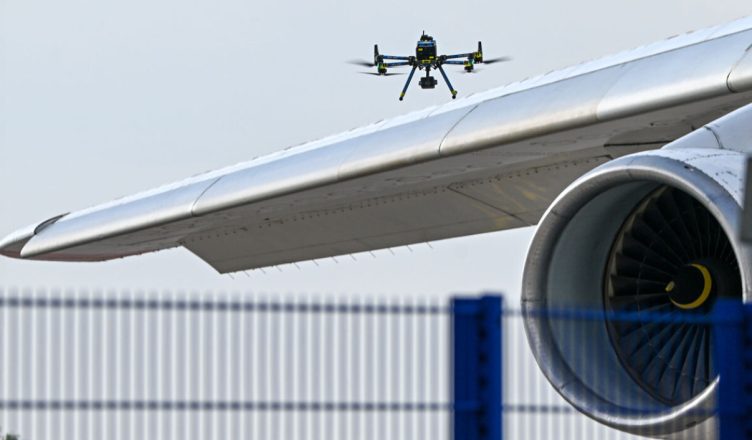
Tensions between Germany and Russia are escalating after a drone incident at Leipzig airport. Berlin accuses Moscow of a hybrid attack, while Russia categorically denies these accusations.
In this situation, the European Union and NATO are discussing a joint response. European Commission President Ursula von der Leyen and NATO Secretary General Mark Rutte are expected to hold a meeting where the focus will be on strengthening cooperation against hybrid threats.
Meanwhile, EU and NATO foreign ministers are considering new measures against Russia. Germany has called for European-level measures against the so-called Russian “shadow fleet” and other sanctions.
Berlin: This is not an isolated incident
German Interior Minister Alexander Dobrindt stated that German authorities have found elements that, according to them, link Russia to the incident in Leipzig.
It concerns the characteristics of the drone, the parts used, the explosives, and the similarities with the modus operandi of previous Russian operations in Europe.
Dobrindt said the incident should not be seen as an isolated event, but as part of a broader campaign of hybrid operations.
“We are not at war, but we are the target of hybrid warfare every day,” the German minister declared.
According to German authorities, a drone equipped with explosives was discovered on August 4 near Ukrainian transport planes. The explosive device did not work. It is also suspected that another drone may have collided with a cargo plane that was nearby.
As part of its response to the situation, Germany has announced that it will close the “Russia House” in Berlin and the Russian Consulate in Bonn on September 18.
The decision has been welcomed by European institutions, Berlin’s partners and NATO.
European Commission President Ursula von der Leyen stated that hybrid attacks cannot remain without a clear response.
Even French President Emmanuel Macron said that such attacks are increasing in Europe and cannot remain without a reaction.
Moscow warns of retaliation
Russia has rejected the German accusations.
Russian Foreign Ministry spokeswoman Maria Zakharova said Berlin was using an “unfounded excuse” to escalate bilateral relations.
She also warned that Russia would respond to Germany’s measures.
NATO and EU seek a common stance
NATO Secretary General Mark Rutte said that Russia’s efforts to intimidate European countries and weaken support for Ukraine will fail.
The Greek Prime Minister, Kyriakos Mitsotakis, also expressed himself along the same lines, declaring Greece’s solidarity with Germany.
Support for Berlin has also been expressed by Great Britain, Italy, Sweden, Finland, Ireland and Ukraine.
European Commission Representative Paula Pinho confirmed that a meeting of Foreign Ministers is being prepared, with a focus on strengthening cooperation between the EU and NATO against hybrid threats.
Eyes from Washington
One of the main question marks remains the position of the United States.
While European countries and NATO are expressing support for Germany and calling for a joint response to Russia, Washington has so far not given a clear public reaction.
The key question is whether the US administration will publicly support Germany and its European allies, or try to reduce tensions with Moscow.
An answer to this issue may come after the meeting between von der Leyen and Rutte and the discussions of the foreign ministers.