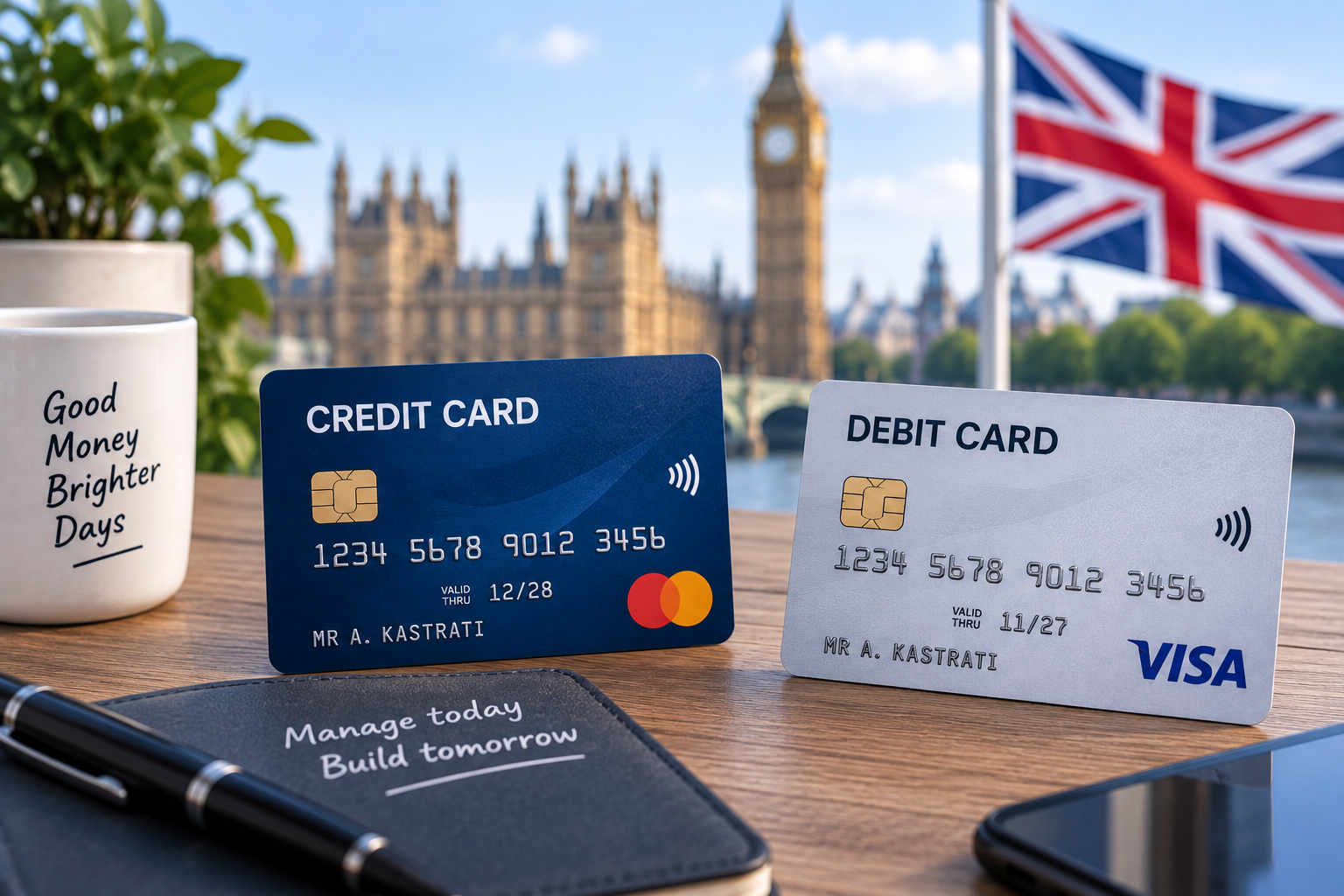
Credit Card vs Debit Card in the UK: What’s the Difference?
You walk into a shop in the UK and pay £50 with a card.
Whether you use a credit card or a debit card, the experience at the checkout can look almost identical.
Tap the card. Payment approved. Done.
But financially, the two transactions are very different.
With a debit card, you’re generally spending money from your own bank account. With a credit card, you’re normally borrowing money from the card provider and agreeing to repay it.
For Albanians living in the UK—especially people who have recently arrived and are beginning to build a UK financial history—understanding this difference can be extremely important.
Credit cards can help you build a credit history when managed responsibly, but they can also become expensive debt when used incorrectly.
Here’s what you need to know.
1. What Is a Debit Card?
A debit card is normally connected directly to your current account.
Suppose your bank account contains:
£2,000
You use your debit card to spend:
£150
The money is generally taken from your available bank balance.
You are spending your own money rather than borrowing £150 from a credit-card company.
Your remaining balance would broadly be:
£1,850
assuming no other transactions or account arrangements affect it.
This makes debit cards relatively straightforward for everyday spending.
2. What Is a Credit Card?
A credit card works differently.
The card provider gives you access to a line of credit up to an agreed limit.
For example:
Credit limit: £3,000
You spend: £500
Remaining available credit: £2,500
The £500 purchase hasn’t been paid using money directly from your current account.
You’ve borrowed £500 from the credit-card provider.
You’ll then receive a statement showing what you owe and when payment is due.
3. The Biggest Difference: Your Money vs Borrowed Money
A simple way to remember the difference is:
Debit card = your money
Credit card = borrowed money
This distinction affects almost everything else.
With a debit card, spending generally reduces your bank balance.
With a credit card, spending generally increases the amount you owe.
That’s why a £1,000 credit-card limit shouldn’t be viewed as:
“I have an extra £1,000.”
You don’t.
You have permission to borrow up to £1,000 under the card’s terms.
4. Credit Cards Have a Credit Limit
Your provider decides how much credit to offer.
You might receive a limit of:
£500
£1,500
£3,000
£10,000
or another amount.
The limit can depend on the lender’s assessment and your circumstances.
If you have a £2,000 limit and spend £1,700, you have used:
85% of your credit limit.
That can matter for your overall credit profile.
Don’t treat the maximum limit as a spending target.
5. A Credit Card Can Affect Your Credit History
This is one of the biggest differences between the two cards.
A credit card is a credit agreement and can form part of your credit history.
Your credit report can reflect information such as:
Your credit account
Balance
Credit limit
Payment history
Whether payments were missed
How the account has been managed
Responsible use over time can help demonstrate that you can manage borrowing.
Missed payments and excessive debt can do the opposite.
6. Does a Debit Card Build Your Credit Score?
Simply spending money with an ordinary debit card generally doesn’t build a traditional borrowing history in the same way as responsibly managing a credit card.
Why?
Because when you buy £60 of groceries using a debit card, you’re normally spending £60 that already belongs to you.
You’re not borrowing £60 and demonstrating that you can repay a credit agreement.
This is why someone can use a debit card for years and still have a relatively limited credit history if they have few or no reported credit accounts.
7. Why This Matters for New Arrivals in the UK
Imagine you’ve recently moved to England.
You open a UK current account and receive a debit card.
You use it responsibly for:
Rent
Food
Transport
Shopping
Bills
After a year, you’ve never overdrawn the account.
That’s good money management.
But it doesn’t necessarily create the same credit history as successfully managing reported credit commitments.
For newcomers, having little UK credit history can sometimes make borrowing more difficult.
This doesn’t necessarily mean you have bad credit.
It may mean lenders have limited UK information about your borrowing history.
8. How a Credit Card Can Help Build Credit
Suppose you’re approved for a card with a:
£1,500 limit
Each month, you use it for:
Phone bill: £30
Fuel: £80
Groceries: £100
Total: £210
You then repay the statement balance in full and on time.
You’re using the credit facility without turning it into long-term debt.
Over time, this can contribute to a history showing responsible management of credit.
You don’t need to make huge purchases to build a credit history.
9. You Do Not Need to Pay Interest to Build Credit
This is one of the most expensive credit-card myths.
Some people believe:
“I need to leave £50 or £100 unpaid every month so my credit score improves.”
No.
You do not need to deliberately pay interest simply to build a credit history.
If you repay your statement balance in full and on time, purchases can generally avoid interest under the card’s applicable interest-free period and terms.
Always check your particular card agreement.
Building credit should not require intentionally paying unnecessary interest.
10. What Is APR?
Credit cards commonly advertise an APR, or Annual Percentage Rate.
APR is designed to help represent the cost of borrowing, incorporating interest and certain charges under standard assumptions.
For example, you might see a card advertised with an APR in its terms.
That does not mean the provider simply deducts that exact percentage from every purchase immediately.
How much interest you actually pay depends on factors such as:
How much you borrow
Whether you repay in full
How long you carry a balance
The interest rate applying to your account
The type of transaction
Your card’s terms
APR becomes particularly important when you’re planning to carry debt rather than repay the statement in full.
11. What Happens If You Pay Only the Minimum?
Your credit-card statement usually provides a minimum payment.
Suppose you owe:
£2,000
Your required minimum payment might be much smaller than £2,000.
Paying only that minimum can keep the account from immediately becoming overdue, assuming it is paid correctly and on time.
But it can also mean the remaining balance continues for a long time and accumulates interest.
This can make the original purchases significantly more expensive.
Whenever possible and appropriate for your finances, paying the statement balance in full avoids turning everyday spending into long-term expensive debt.
12. Never Miss the Payment Due Date
A credit card creates a repayment obligation.
Missing payments can lead to:
Late-payment consequences
Potential fees depending on the card terms
Interest
Damage to your credit history
Difficulty obtaining future credit
If you’re worried you’ll forget, consider setting up a Direct Debit.
For example, you might set it to pay the full statement balance if your finances allow.
Just make sure sufficient money is available in your bank account when the payment is collected.
13. Credit Utilisation Matters
Suppose you have:
Credit limit: £4,000
Balance: £3,600
You’re using:
90% of your available limit.
Even if you haven’t missed a payment, consistently using most of your available credit can make you appear financially stretched.
Compare that with:
Credit limit: £4,000
Balance: £600
Utilisation:
15%
There is no single utilisation percentage that guarantees a good credit score or approval.
But generally, avoiding constantly maxing out your cards can support a healthier credit profile.
14. Credit Cards Can Offer Extra Purchase Protection
One major UK-specific difference involves Section 75 of the Consumer Credit Act 1974.
For qualifying purchases, a credit-card provider can share responsibility with the seller if something goes wrong.
Section 75 can potentially apply when the cash price of an item or service is more than £100 and no more than £30,000, provided the legal requirements are met.
For example, imagine you buy qualifying furniture costing:
£1,500
using your credit card.
The retailer later goes out of business without delivering the goods.
Depending on the circumstances, Section 75 could potentially provide an important route for recovering your money from the credit provider.
This protection is one reason some consumers choose credit cards for larger purchases.
15. Debit Cards Have Different Protection
Debit-card purchases don’t receive Section 75 protection in the same way.
However, chargeback may be available in certain situations through card schemes.
Chargeback isn’t the same legal protection as Section 75.
Its rules and time limits can differ.
So don’t assume debit and credit cards provide identical protection simply because both display Visa or Mastercard branding.
16. Example: Buying a £1,200 Laptop
Suppose you want to purchase a laptop costing:
£1,200
Option A: Debit Card
You have £3,000 in your current account.
You pay £1,200.
Your balance falls to approximately:
£1,800
You used your own money.
Option B: Credit Card
Your credit limit is £4,000.
You pay £1,200 on the card.
You now owe approximately:
£1,200
and have:
£2,800
of available credit remaining.
If you later repay the full statement balance according to the card’s terms, you can potentially avoid purchase interest.
But if you carry the £1,200 debt for months, interest could make the laptop considerably more expensive.
Same laptop.
Same £1,200 checkout price.
Very different financial transaction.
17. What About Cash Withdrawals?
Using a credit card to withdraw cash can be expensive.
Cash transactions can have:
Cash-advance fees
Interest
Different interest treatment from normal purchases
Potential implications for how lenders view your credit behaviour
Don’t assume a £200 ATM withdrawal on a credit card works like a £200 shop purchase.
Check your card terms before using a credit card for cash.
A debit card is generally much more natural for accessing money already held in your current account, although ATM and foreign-use fees can still depend on your bank and location.
18. What Happens When You Travel Abroad?
Both debit and credit cards can charge fees for overseas transactions depending on the provider.
Possible charges can include:
Foreign transaction fees
Currency conversion costs
ATM fees
Cash withdrawal fees
Don’t assume your card is “free abroad” because it works internationally.
Before travelling from the UK to Albania, Kosovo, Europe, the United States or elsewhere, check the foreign-use terms of both cards.
19. Fraud Protection Matters for Both
If your card is lost, stolen, or used without permission, contact the card provider quickly.
UK rules provide protections around unauthorised transactions, but the exact outcome can depend on circumstances.
Monitor your accounts regularly.
Turn on transaction notifications if your bank offers them.
If you see:
£499 purchase — retailer you don’t recognise
don’t wait three months to investigate.
Report suspicious transactions as soon as possible.
20. Which Card Is Better for Everyday Spending?
There isn’t one answer for everyone.
A debit card can be useful when:
You want to spend only money you already have.
You want simple budgeting.
You don’t want to borrow.
You’re concerned that access to credit would encourage overspending.
A credit card can be useful when:
You’re building a UK credit history.
You can repay the balance responsibly.
You want potential Section 75 protection for qualifying purchases.
Your card offers useful benefits that genuinely exceed its costs.
But credit cards become dangerous when they’re used to finance a lifestyle you cannot afford.
21. Example: Responsible vs Risky Credit-Card Use
Consider two people with identical:
£2,000 credit limits
Person A
Spends £250 per month.
Tracks every purchase.
Pays the statement balance in full.
Never misses the due date.
Keeps emergency savings.
Person B
Spends £1,900.
Pays only the minimum.
Uses the card because their salary has already been spent.
Withdraws cash on the credit card.
Continues adding new purchases every month.
Both have credit cards.
But their financial outcomes can be completely different.
A credit card is a tool.
How you use it matters.
22. Credit Cards Aren’t Free Emergency Funds
A £5,000 credit limit isn’t the same thing as having:
£5,000 in savings.
If your car breaks down and you put a £2,500 repair on a credit card, you’ve solved the immediate payment problem.
But you’ve also created £2,500 of debt.
If that balance remains unpaid and attracts interest, the repair can become substantially more expensive.
A genuine emergency fund is money you own.
A credit limit is money you can borrow.
Don’t confuse them.
23. Credit Cards and Mortgages
If you plan to buy a home in the UK, how you manage credit can become important.
Mortgage lenders can examine factors including:
Your income
Existing debts
Monthly commitments
Credit history
Recent applications
Affordability
Deposit
A credit card itself isn’t automatically bad for a mortgage application.
Responsible management can contribute to your credit history.
But large outstanding balances, missed payments and excessive borrowing can create problems.
If you’re preparing for a mortgage, manage credit carefully rather than suddenly applying for multiple new cards or loans.
Credit Card vs Debit Card: Quick Comparison
Debit Card
Uses: Your own money
Connected to: Bank/current account
Creates debt: Normally no, unless another facility such as an overdraft is involved
Can build borrowing history simply through purchases: Generally no
Interest on normal purchases: Normally no
Section 75: No
Useful for: Everyday spending and budgeting
Credit Card
Uses: Borrowed money
Connected to: Credit account
Creates debt: Yes
Can contribute to credit history: Yes
Interest possible: Yes
Section 75: Potentially available for qualifying purchases
Useful for: Responsible credit building, certain purchase protections and short-term payment flexibility
Seven Rules for Using a Credit Card Responsibly
1. Don’t spend money just to build credit.
Use the card for purchases you would make anyway.
2. Pay on time every month.
A Direct Debit can help.
3. Consider paying the statement balance in full.
This can help you avoid unnecessary purchase interest where the card terms allow.
4. Don’t constantly max out your limit.
Keep borrowing manageable.
5. Avoid unnecessary cash withdrawals.
Credit-card cash transactions can be expensive.
6. Read the APR, fees and card terms.
Don’t choose a card based only on advertising.
7. Remember that credit isn’t income.
A £10,000 credit limit doesn’t make you £10,000 richer.
The Bottom Line
For Albanians living in the UK, the simplest distinction is:
Debit card = spend your own money.
Credit card = borrow the card provider’s money and repay it.
A debit card is usually the simpler option for managing everyday money already in your bank account.
A credit card can provide additional benefits—including helping establish a credit history and potentially offering Section 75 protection on qualifying purchases—but only when used responsibly.
The biggest mistake is treating available credit as extra income.
If you use a credit card, keep the basic strategy simple:
Buy what you can afford → monitor your balance → pay on time → avoid unnecessary interest → protect your credit history.
Used carefully, a credit card can be a useful financial tool.
Used as a way to continually spend money you don’t have, it can turn ordinary purchases into expensive long-term debt.
Disclaimer: This article is for general educational purposes only and does not constitute personalised financial, credit, debt, mortgage, tax or legal advice. Credit-card rates, fees, eligibility requirements and lender criteria vary. Section 75 and chargeback protections depend on the circumstances of the transaction. Always check the terms of your specific financial product before borrowing or making a major purchase.