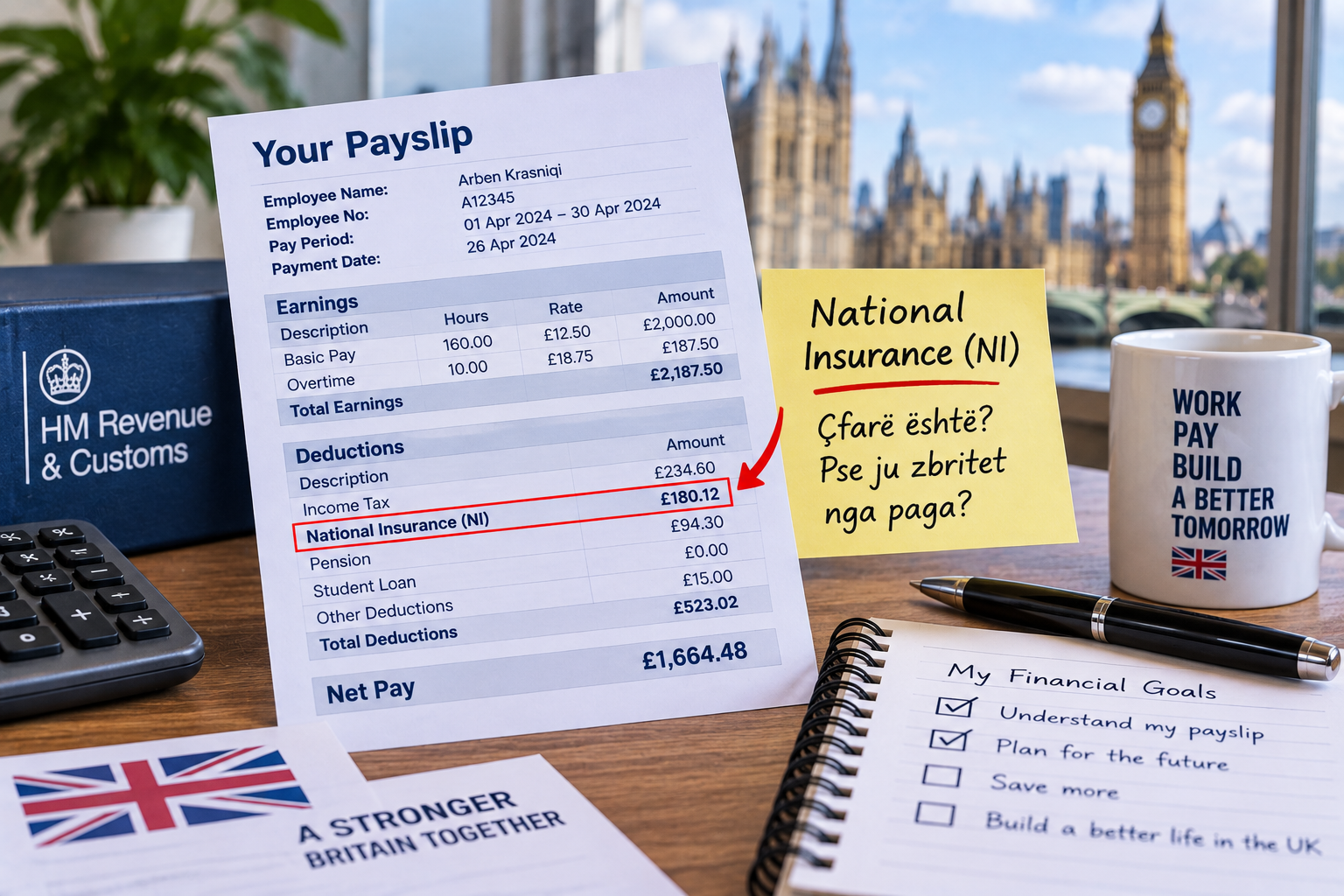
# National Insurance: What Is It and Why Is It Deducted From Your Pay?
If you work in the United Kingdom and regularly check your payslip, you’ve probably noticed a deduction called **National Insurance**, **NI**, or sometimes **NICs**.
For someone who has recently started working in the UK, especially an Albanian who is unfamiliar with the British payroll system, this can raise an obvious question:
**Why is money being taken from my salary for National Insurance when I’m already paying Income Tax?**
The first thing to understand is that **Income Tax and National Insurance are not the same thing**.
They are calculated separately and can both appear on your payslip.
National Insurance contributions are connected to the UK’s social security system and can help determine entitlement to certain benefits and the State Pension.
Here’s what employees should understand about National Insurance and why it appears on their wages.
## 1. What Is National Insurance?
National Insurance is a system of contributions paid by workers and employers under UK rules.
For employees, National Insurance contributions are generally deducted through payroll when earnings meet the applicable requirements.
If you’re an employee, you may see something like:
**National Insurance**
**NI**
or
**NIC**
on your payslip.
The amount isn’t necessarily the same every month.
It can depend on your earnings and the National Insurance rules applying to your employment.
## 2. National Insurance Is Different From Income Tax
This is one of the most common points of confusion.
Suppose your payslip shows:
Gross pay: **£3,000**
PAYE Income Tax: **£300**
National Insurance: **£120**
Pension: **£100**
Net pay: lower than your original £3,000 gross salary.
You might wonder why you’re being “taxed twice.”
The reason is that PAYE Income Tax and employee National Insurance contributions are separate deductions with different rules.
Your Income Tax calculation can involve your taxable income, tax code, Personal Allowance and applicable tax bands.
National Insurance uses its own contribution rules and earnings thresholds.
Therefore, paying Income Tax does not mean National Insurance is already included in that deduction.
## 3. Who Pays National Insurance?
Different National Insurance rules can apply depending on how you work.
For many employees, **Class 1 National Insurance contributions** are relevant.
The employer generally handles the calculation through payroll and deducts the employee contribution when required.
Employers can also have their own National Insurance obligations.
This means the National Insurance amount you see deducted from your paycheck is not necessarily the total National Insurance-related cost associated with employing you.
The employer’s contribution is separate from the employee amount deducted from wages.
Self-employed people can face different National Insurance and tax rules depending on their circumstances.
So don’t assume the payroll system for an employee is identical to the system for someone running their own business.
## 4. Why Does National Insurance Matter?
National Insurance contributions and credits can affect entitlement to certain UK benefits.
One of the most important areas is the **State Pension**.
Your National Insurance record can play an important role in determining whether you qualify for the State Pension and potentially how much you’re entitled to receive.
This means National Insurance isn’t simply a random line removed from your paycheck.
Your NI record can become important many years later when you’re approaching retirement.
## 5. What Is Your National Insurance Record?
Over your working life, the UK system keeps a record of your National Insurance contributions and certain credits.
A year may count as a **qualifying year** toward the State Pension when the relevant conditions are satisfied.
This is why someone approaching retirement shouldn’t ask only:
**“How many years have I lived in Britain?”**
A more useful question can be:
**“What does my National Insurance record actually show?”**
Living in the UK and building a qualifying National Insurance record aren’t necessarily the same thing.
If you’re planning for retirement, checking your actual record can be extremely useful.
## 6. Does Everyone Pay the Same Amount?
No.
National Insurance is not simply one identical fixed monthly charge for every employee.
The amount can depend on your earnings and the thresholds and rates applying during the relevant tax year.
Someone earning £2,000 per month may therefore have a different National Insurance deduction from someone earning £4,000 per month.
And if your earnings change because of overtime, bonuses, or other payments, your deduction may also change.
This is why comparing your National Insurance line directly with a coworker’s doesn’t necessarily tell you whether yours is correct.
## 7. Why Did My National Insurance Increase This Month?
Imagine your normal monthly salary is:
**£2,500**
This month, you work overtime and your gross pay becomes:
**£3,300**
You then notice that your National Insurance deduction is higher.
That does not automatically mean payroll made a mistake.
Because National Insurance calculations are connected to earnings, changing earnings can change the contribution.
This is particularly relevant for workers whose income varies from pay period to pay period.
Your payslip should therefore be read as a whole.
Compare:
Gross pay
Hours worked
Overtime
Income Tax
National Insurance
Pension
Net pay
Looking only at one deduction can give you an incomplete picture.
## 8. What Is a National Insurance Number?
Your **National Insurance number** is used to help ensure that your National Insurance contributions and tax-related information are associated with your record.
You may see your NI number on payroll or employment documents.
It is personal information and should be protected appropriately.
Your National Insurance number is not the same thing as your National Insurance contribution.
The **number identifies your record**.
The **contribution is the money paid under National Insurance rules**.
That’s an important distinction for people who are new to the UK system.
## 9. National Insurance and Your State Pension
For many workers, retirement is where their National Insurance record becomes particularly important.
Under current UK State Pension rules, qualifying years on your National Insurance record can affect entitlement.
However, the exact amount of State Pension you may receive depends on your individual record and applicable rules.
Don’t simply assume:
“I’ve worked in England for 20 years, so I know exactly what pension I’ll receive.”
Check your actual State Pension forecast and National Insurance record.
This becomes especially important for immigrants who may have started working in the UK later in life.
## 10. What If There Are Gaps in Your National Insurance Record?
Your NI record can contain gaps for various reasons.
For example, there may have been years when you:
Didn’t work
Had low earnings
Lived outside the UK
Were self-employed under different circumstances
Were caring for someone
Had another situation affecting your contribution record
A gap doesn’t automatically mean you’ll have a pension problem.
Some people can receive **National Insurance credits** in certain circumstances, and there are situations where voluntary contributions may be relevant.
But don’t pay voluntary contributions blindly.
Whether filling a gap actually improves your future State Pension can depend on your individual record.
Check your record and, where appropriate, obtain guidance before paying money simply because you see a missing year.
## 11. Can You Check Your National Insurance Record?
Yes.
The UK government provides services that allow eligible users to check their National Insurance record.
Depending on the information available, you can see things such as qualifying years and potential gaps.
This can be especially valuable if you’re over 40 or 50 and beginning to think seriously about retirement.
You should also consider checking your **State Pension forecast**.
The two pieces of information work together.
One shows your contribution history.
The other helps you understand what your future State Pension could look like under current rules.
## 12. What If You Worked Outside the UK?
This is particularly relevant for Albanian immigrants.
Suppose you worked for many years outside Britain before moving to England.
Don’t automatically assume those years will appear as normal UK National Insurance qualifying years.
International social security arrangements can be complicated and depend on the countries involved, your employment history, and applicable agreements.
If you’ve divided your career between the UK and another country, check how the rules apply to your specific circumstances.
Do this before retirement rather than assuming every year worked abroad will automatically increase your UK State Pension.
## 13. What If You Have Two Jobs?
Having two jobs can make your payslips more complicated.
Each employment can have its own payroll calculations.
You might therefore see National Insurance deductions on more than one payslip depending on your earnings and circumstances.
Income Tax and National Insurance also do not necessarily operate identically across multiple employments.
If you have two jobs, review each payslip separately rather than simply combining the gross salaries and trying to calculate everything using one percentage.
## 14. National Insurance and Workplace Pensions Are Different
Another common misunderstanding is confusing National Insurance with a workplace pension.
They are separate.
Your payslip could show:
**National Insurance: £___**
and
**Pension contribution: £___**
National Insurance contributes to the wider social security system and can affect eligibility for certain benefits, including the State Pension.
A workplace pension is a separate retirement arrangement where contributions are generally made into a pension scheme for you, subject to that scheme’s rules.
You may eventually have retirement income from both:
**State Pension**
and
**Workplace/private pension savings**
Don’t treat the two as the same account.
## 15. Does Paying More NI Automatically Mean You’ll Get a Huge Pension?
No.
You should not think of National Insurance as a personal savings account where every pound deducted is stored under your name and later returned to you.
The State Pension operates according to government rules and your qualifying record.
The amount you receive isn’t simply calculated by adding up every pound of National Insurance you’ve ever paid.
That’s why two people who have paid different amounts during their careers can still need to look at their qualifying years and individual State Pension records to understand their entitlement.
## A Simple Payslip Example
Imagine an Albanian worker in England receives this hypothetical payslip:
**Gross pay: £2,900**
Then deductions appear:
Income Tax: **£280**
National Insurance: **£125**
Workplace pension: **£110**
Other deduction: **£25**
Total deductions:
**£540**
Estimated net pay:
**£2,360**
The important point isn’t the exact numbers—these are only illustrative.
It’s understanding that the £125 National Insurance deduction is separate from the £280 Income Tax deduction.
And the £110 pension contribution is another separate item.
Three different deductions can serve different purposes and operate under different rules.
## What Should You Check on Your Payslip?
When you receive your next payslip, don’t look only at the final payment.
Check:
**Gross pay** — Is your salary correct?
**Hours** — Were you paid for the hours you expected?
**PAYE Income Tax** — How much was deducted?
**National Insurance** — How much NI was deducted?
**Pension** — Is your contribution shown correctly?
**Other deductions** — Do you understand them?
**Net pay** — Does it match the amount paid into your account?
If your National Insurance amount suddenly changes significantly, compare the payslip with the previous pay period.
Your earnings may have changed.
If you still can’t explain the difference, contact payroll or check the relevant HMRC information.
## Approaching Retirement? Check This Before You Stop Working
If you’re approaching retirement age, don’t assume everything is ready simply because National Insurance has appeared on your payslips for years.
Check your actual **National Insurance record**.
Then check your **State Pension forecast**.
Ask:
How many qualifying years do I have?
Are there gaps in my record?
Why do those gaps exist?
Could any missing years affect my State Pension?
Would making voluntary contributions actually benefit me?
What does my current State Pension forecast show?
Answering these questions while you’re still working can be far more useful than discovering an unexpected issue after retirement.
## The Bottom Line
If you work in England and see **National Insurance** deducted from your paycheck, remember that it is not simply another name for Income Tax.
They are separate.
For employees, National Insurance is generally handled through payroll according to your earnings and applicable contribution rules.
Your National Insurance history can also become important when determining entitlement to certain benefits, particularly the **UK State Pension**.
For Albanians working in Britain, the most important lesson is:
**Don’t just check how much money was deducted today—understand what your National Insurance record looks like for the future.**
Read your payslip, monitor your NI deductions, protect your National Insurance number, and periodically check your contribution record.
Especially as retirement approaches, understanding your **National Insurance record and State Pension forecast** can be much more valuable than simply knowing the amount that disappeared from this month’s paycheck.
*Disclaimer: This article is for general educational purposes only and does not constitute tax, pension, financial, employment, or legal advice. National Insurance rates, thresholds, State Pension rules, and eligibility requirements can change. Individual circumstances vary, so check current information with HMRC and GOV.UK before making financial or retirement decisions.*