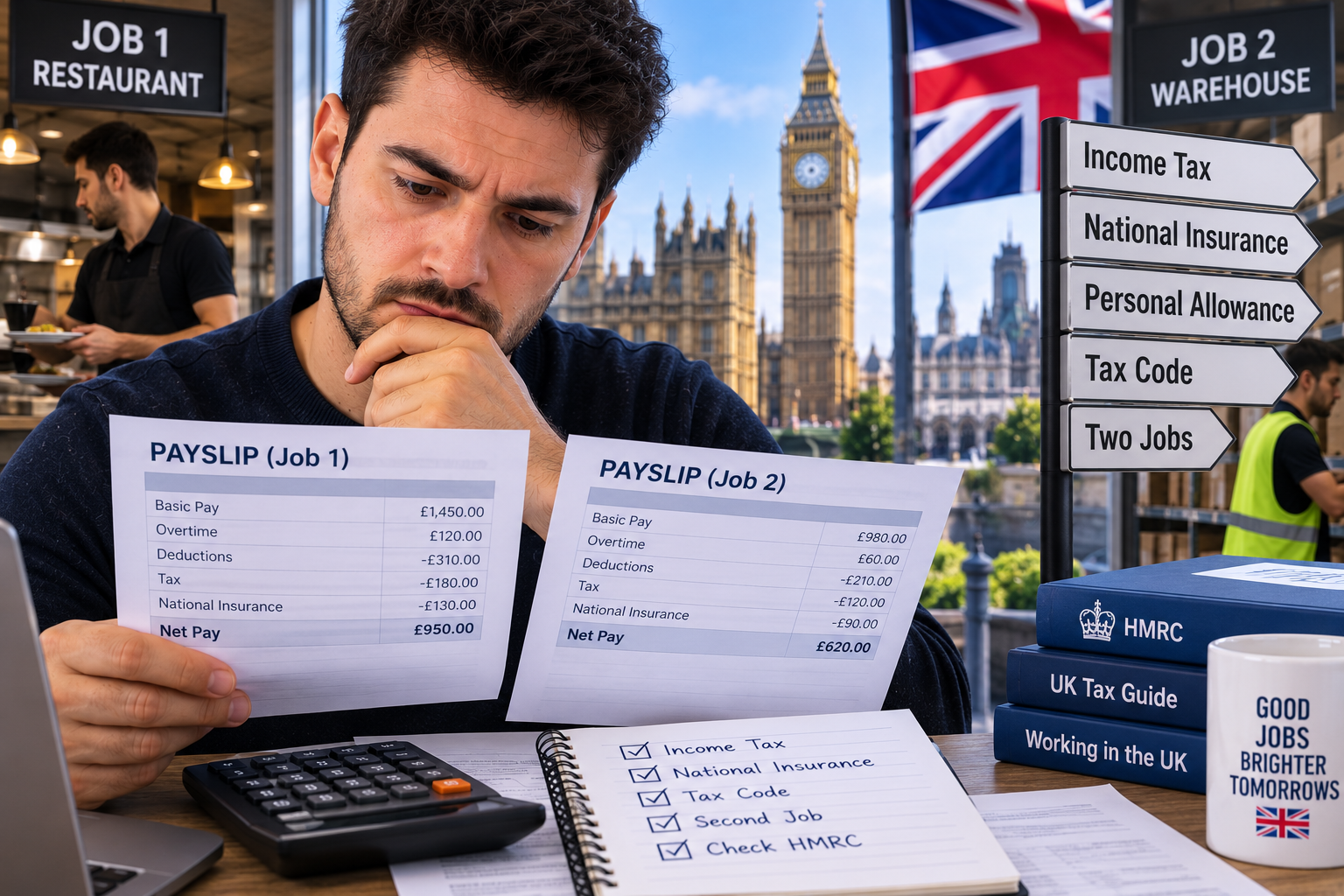
Working Two Jobs in England? What Happens to Your Taxes?
Working two jobs is common across England. You might have one full-time job during the week and work evenings or weekends somewhere else.
For many Albanians living in the UK, a second job can be a practical way to increase household income, save for a home, pay down debt, or simply manage higher living costs.
But once the second paycheck arrives, many workers notice something unexpected:
The tax code may be different, and the amount of tax deducted may seem much higher.
Does having two jobs mean you’re being taxed twice? Do you receive the Personal Allowance twice? What happens to National Insurance? And why might a second job show a tax code such as BR?
Here’s how the system generally works.
1. You Don’t Get a Separate Personal Allowance for Every Job
This is one of the most important things to understand.
Your Personal Allowance is not normally duplicated simply because you have two employers.
For many taxpayers, the standard Personal Allowance is an amount of income they can receive before paying Income Tax, subject to their individual circumstances and the rules for the relevant tax year.
HMRC uses your tax codes to help determine how your allowance and tax should be handled through PAYE.
Often, an individual’s allowance may primarily be reflected in the tax code used for one employment.
Your second job can therefore have a different tax code.
That is normal in many situations.
2. Why Might Your Second Job Show “BR”?
Some workers with a second job see:
BR
on one of their payslips.
BR generally means that income from that employment is being taxed at the basic rate, without the Personal Allowance being applied to that particular source of income.
That can make the deduction look surprisingly large.
For example, imagine you earn:
Main job: £30,000 per year
Second job: £8,000 per year
You shouldn’t simply assume that the normal Personal Allowance starts again from zero for your second £8,000.
Your overall Income Tax position takes your circumstances and income sources into account.
A BR code can therefore be appropriate for some second jobs.
However, it isn’t automatically correct for every person.
If you believe your tax code doesn’t reflect your circumstances, check what HMRC has on record.
3. Your Total Income Matters for Income Tax
Suppose you have:
Job 1: £32,000 per year
Job 2: £12,000 per year
Your combined gross employment income would be:
£44,000 per year
Your overall Income Tax position is not based on pretending that these are two unrelated people each earning their own salary.
Your income from different sources can contribute to your overall tax position.
This becomes particularly important when additional earnings cause part of your taxable income to enter a different Income Tax band.
4. A Higher Tax Band Doesn’t Mean Your Entire Salary Is Taxed at That Rate
This is a very common misunderstanding.
Imagine your additional income causes part of your taxable income to move into a higher Income Tax band.
Some people think:
“Now all my income will be taxed at the higher rate.”
That’s generally not how marginal Income Tax bands work.
Instead, different portions of taxable income can be taxed at different rates.
Only the portion falling into a higher band is generally subject to that higher rate.
So earning more does not normally mean you suddenly take home less overall simply because part of your income entered another tax band.
5. PAYE Is Calculated Through Each Employer’s Payroll
Most employees pay Income Tax through PAYE — Pay As You Earn.
Each employer processes payroll using the tax code and information available for that employment.
This is why your two payslips can look very different.
For example:
Main Job
Gross monthly pay: £2,700
Tax code: one reflecting your available allowance
PAYE Income Tax: deducted according to that code
Second Job
Gross monthly pay: £700
Tax code: potentially BR or another applicable code
PAYE Income Tax: deducted separately
The exact numbers depend on your circumstances.
The important point is that each employer is processing its own payroll rather than one employer calculating tax on both salaries.
HMRC’s records and tax codes help coordinate the overall position.
6. What Happens to National Insurance With Two Jobs?
National Insurance is another area that can confuse workers.
Income Tax and National Insurance do not operate in exactly the same way.
For employees, Class 1 National Insurance is generally calculated by each employer according to the earnings in that employment and the applicable rules.
That means you should not assume National Insurance will simply be calculated by adding both monthly salaries together and applying one universal percentage yourself.
If you have two jobs, you may see National Insurance deducted on one or both payslips depending on the earnings and circumstances.
Special rules can also apply in certain situations involving multiple employments.
This is one reason online “two-job tax” calculations can be misleading if they oversimplify National Insurance.
7. Your Second Job Isn’t Automatically “Taxed More”
Imagine your second payslip shows a relatively high percentage going toward PAYE.
It can feel like the government is punishing you for taking a second job.
But often the explanation is simpler:
Your Personal Allowance may already be accounted for through your main employment.
Therefore, income from your second employment may have Income Tax deducted without another allowance being applied there.
This can make the second payslip look heavily taxed even though the calculation may make sense in the context of your overall income.
8. What If HMRC Doesn’t Know You Have Two Jobs?
When your employment circumstances change, HMRC needs accurate information to calculate appropriate tax codes.
If information about one of your jobs is missing, outdated, or incorrect, you could potentially end up with a tax code that doesn’t reflect your current situation.
That’s why you should check your tax information after:
Starting a second job
Leaving one of your jobs
Receiving a major pay increase
Changing employers
Noticing a new tax code
Receiving an unexpected tax deduction
Don’t simply wait until the end of the tax year if something clearly looks wrong.
9. Starting a Second Job? Check Your First Payslip Carefully
The first payslip from a new employer deserves special attention.
Check:
Your name
National Insurance number where shown
Pay period
Hours worked
Hourly rate or salary
Gross pay
Tax code
PAYE deduction
National Insurance
Pension deduction
Net pay
If your tax code doesn’t look familiar, don’t immediately assume it’s wrong.
But do find out what it means.
A few minutes spent understanding the first payslip can prevent months of confusion.
10. What If Too Much Tax Is Taken?
Sometimes tax can be overpaid.
For example, circumstances can change during the year, tax codes can be adjusted, or HMRC may later determine that more tax was deducted than ultimately due.
How an overpayment is corrected depends on the circumstances.
It may sometimes be adjusted through PAYE, while in other situations HMRC may calculate a refund after reviewing the relevant tax information.
Don’t rely on the assumption that “HMRC will eventually fix everything automatically.”
Check your tax code and employment information if you believe the deductions are wrong.
11. What If Too Little Tax Is Taken?
The opposite can happen too.
A low deduction doesn’t necessarily mean you’ve found a way to legally avoid tax.
If insufficient Income Tax is collected during the year, you may later discover that additional tax is due.
That can happen when HMRC receives updated information about your total income or circumstances.
Therefore, if you have two jobs and one seems to be deducting almost no tax when you expected otherwise, investigate the reason.
A larger paycheck today isn’t always good news if the underlying tax calculation is incorrect.
12. Do You Need to File a Self Assessment Just Because You Have Two Jobs?
Having two PAYE jobs does not automatically mean every employee must file a Self Assessment tax return.
Many people can have tax collected through PAYE from multiple employments without filing a return solely because they have two jobs.
However, Self Assessment requirements can arise for other reasons depending on your income and circumstances.
For example, you might have self-employment income, certain untaxed income, capital gains, or other circumstances requiring a return.
Check the current HMRC criteria rather than assuming that a second job automatically creates a filing requirement.
13. What If Your Second “Job” Is Actually Self-Employment?
This is an important distinction.
Imagine you work full-time as an employee but earn additional money in the evenings doing independent work.
Your situation may not actually be:
Job 1 + Job 2
It could instead be:
Employment + self-employment
Tax reporting can then work differently.
Your employer handles PAYE for your normal job, while you may have separate responsibilities for self-employment income depending on your circumstances and applicable rules.
Don’t assume that because tax is deducted from your main salary, your additional business or freelance income has automatically been taxed.
14. Workplace Pensions Can Also Appear on Both Payslips
If you’re eligible for workplace pension arrangements through both employers, pension deductions can add another layer to your payslips.
You might see:
Pension deduction from Job 1
and potentially
Pension deduction from Job 2
depending on eligibility, enrolment, scheme rules, and your decisions.
Remember that a pension deduction is different from Income Tax and National Insurance.
Money going into a workplace pension is generally being directed toward retirement savings under the scheme’s rules.
15. Example: One Job vs. Two Jobs
Consider a hypothetical Albanian worker in England.
Main Job
Annual gross salary: £31,000
Weekend Job
Annual gross salary: £9,000
Combined gross income:
£40,000
It would be incorrect to look at the second £9,000 and automatically assume it receives an entirely separate full Personal Allowance.
Instea