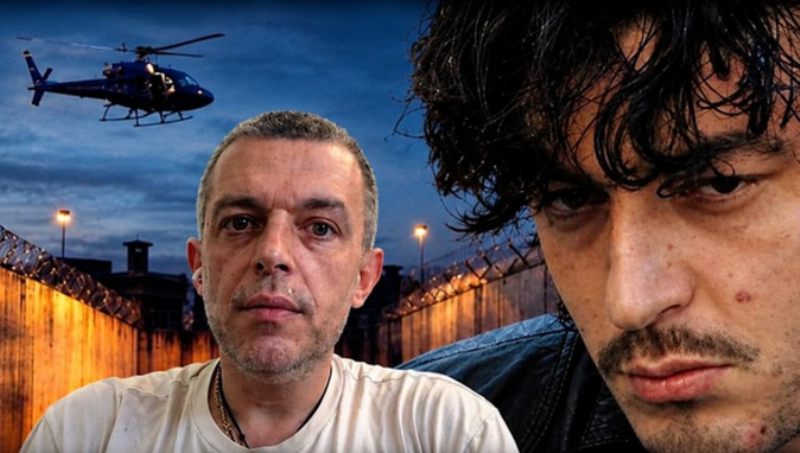
If the history of Albania’s transition had been different, the fate of the hundreds of thousands of young people who emigrated would have been different. Caught between the waves of life, some managed to break through, some remained among them, some sank. Alket Rizai is one of them.
Alket Rizai, 48 years old, was born on May 24, 1978 in the village of Aranitas in Ballsh. Until the age of 16, he lived between Ballsh and his birthplace. The family, consisting of 5 people, two parents and two brothers, have lived in the center of Ballsh for years, where they had an apartment and a small shop with which they barely made a living.
They never forgot their birthplace, the village of Aranitas, where Alketi spent his childhood, and they also built a house in Aranitas in the “Lumar” neighborhood, where Alketi’s father lives most of the time.
In the birthplace of Alket Rizai
The show “Drit’hije” traveled to Alket Riza’s hometown, we contacted his family by phone, his mother, Donika, and his father Ramiz, now in advanced age. In failing health and tired of the many years of waiting, they had decided not to appear on camera and speak to the media since the last time in 2013.
“Thank you, but I don’t speak, I’m tense. I’ve been speaking for 25 years and I’m stressed, God knows,” are the words of Alket Riza’s mother.
At the entrance to Aranitasi is the village pub, where the men of the area used to gather. There we find childhood friends, cousins, relatives and Alket Riza’s uncle who recount many memories with Alket, who has now made his third escape from Greece.
Alketi’s relatives reveal his passions and how he spent his childhood in the village of Kalenjë with his uncles and in Aranitas, two villages next to each other. Since childhood, he had a passion for football and fishing, where he always went fishing in the village river.
Although it is in high demand in the neighboring country, people in the village have a different opinion.
For them, Alketi is not a murderer and they believe that he escaped from prison to prove the opposite of what he was convicted of.
They also link Alket Riza’s sentences to the claims they have about our country’s relations with Greece, because, according to them, the Greek state has not properly treated Albanians in prisons.
Although with suffering and pain, Alket Riza’s family has had their son in prison for about 25 years, his mother has managed to see and meet him in prison in Greece.
It is not a legend, but the Greek police have also searched for him in Aranitas. Residents tell interesting stories from years ago, when Alket Rizai had escaped from prison and the police had come to find him in the village, and once they even thought they had arrested him. In fact, they arrested Alket Rizai, but not the one who had escaped, but a resident who had the same name and surname, so they had let him go.
Alketi’s relatives also have a message for him, as they have not met him for almost 34 years.
From the village of Aranitas we leave to head towards Ballsh, where Alketi lived until the age of 16 and also finished school, although only until the second year of high school, after which he set off for Greece to provide more income for the family. He was the youngest of three boys and was a resourceful and very smart child. Since his childhood at school he had a special passion, which he could perhaps turn into a profession if his future had been different, electronics. At the age of 10 he was fixing all the children in the city’s Rambo computers of that time.
Ballshi, a small town, where when you mention the name of Alket Rizai, everyone turns their heads to listen. In this town, no one has condemned his actions, while the camera of “Drit’hije” stopped in front of the bar and his parents’ apartment in Ballshi. The business is now closed, while the house still has the memories of Alket and his two brothers, who also live abroad.
At the age of 16 in 1994, Alketi illegally left the mountains for Greece to work. The first mountain of his life were the hills of the border between the two countries, which he crossed on foot in the hope of a better life, although history showed otherwise for him.
The turning point of life, from Aranitasi to Greece
Initially, in Greece at a young age Alket worked like all young Albanians after the transition to emigration and with the arrivals he helped his family in Albania. The four foreign languages he spoke came to his aid. Among his acquaintances in his first years in Greece were also charming girls, who saw in him the charming boy who resembled a film actor. Alket connected with a beautiful Russian girl Oksana, and here life took a different course. From a young Albanian who came to Greece at the age of 16, Alket Rizaj evolved into one of the most notorious convicts of the neighboring country.
In 2003, he was convicted of the murder of Thanasis Koropiotis. The incident occurred on May 3, 2003. The perpetrators kidnapped the young Greek and then drove him to the forests of the Attica area in a car, where they executed him and then disappeared the body. Initially, the police arrested three people, two Greeks and a Russian, while a month later the Albanian suspect was also detained. Although convicted, Alket Rizai did not admit to the crime. But the most famous story of his criminal life had not yet been written.
The first spectacular helicopter escape in 2006
In May 2003, prison guards found a detailed prison plan in his cell and immediately transferred him to the Korydallos maximum-security prison near Athens. One of the most notorious in Europe, it was home to murderers, war criminals and terrorists.
Shortly after serving six years of a 25-year sentence for kidnapping and bank robbery, Greek crime boss Vasilis Paleokostas befriended Alket Rizai. It took only 20 days to devise an escape plan. Rizai had spoken to his mother on the phone and told her that “justice would soon be served,” although she had never thought that her son was preparing an escape.
On June 4, 2006, at 6:15 p.m., near Athens, the pilot of a commercial helicopter, named Karikis, was boarding the white Eurocopter AS355N.
The former soldier was offering pleasure trips for the Airlift company, but five minutes after they took off, one of the two passengers put a gun to his neck. The pleasure trip was over, it was Nikos Palekostas and he was going to save his brother, Vasilis, and his friend, the Albanian Alket Rizai.
Within ten minutes, the helicopter could see Korydallos prison and reduced its speed to 70 miles per hour.
“We considered hiring a pilot, but a scared pilot is better,” Rizai declared years ago in a BBC documentary.
The prison guards, thinking it was some prison authority arriving for a surprise inspection, adjusted their uniforms. As the helicopter landed in the training yard, the engines kicked up a storm of brown dust.
The pilot shouted: “They have grenades. They have explosives.” A guard shouted: “Escape, escape.”
It had already begun. Moments later, Vassilis Paleokostas and Rizai boarded the helicopter and it took off. The guards aimed their guns, but they didn’t fire because they knew full well what was going to happen. The prison is in a residential area with orange trees and children were throwing a ball at the prison walls.
Rizai explains: “The ultimate goal in a prison escape is to leave in style and say ‘Cheers’ and ‘Bravo’ as you leave.”
In Schisto, north of Athens, the helicopter landed quietly in a cemetery, where two motorbikes appeared. Paleokostas and Rizai were on their way to freedom.
After escaping from prison in 2006, Alket Rizai was quickly caught. According to police, it is learned that in order to lose track of the Greek police, he changed his hairstyle, grew a beard and dyed his hair, transforming it from black to blonde. On August 2, 2008, Vassilis Paleokostas was also arrested.
While on the run, on August 26, 2006, Rizai is accused of killing 43-year-old Konstantinos Koutelieris and 36-year-old Ioannis Katsios. Rizai denied involvement in the crime at the time and, according to him, the Greek justice system never found evidence implicating him. According to investigations, the murders were carried out on the orders of one of the powerful figures of the Greek mafia, Vasilis Stefanakos, who was killed years later.
The second spectacular helicopter escape in 2009
In 2009, the trial of Alekt Rizai and the Paleokostas brothers for their 2009 escape was to be held in Athens. A crowd gathered outside the courthouse. Farmers, villagers, and anarchists chanted: “Death to the pigs! Freedom for the Paleokostas brothers!” A group of young women invaded the courtroom. At this time, Alekt Rizai’s glamorous girlfriend, Soula Mitropia, made a splash in the courtroom.
As Rizai returned to court to be sentenced to 25 years, his girlfriend began to cry and threw her arms around him. When no one was looking, she slipped a mysterious watch into his pocket. After the trial, the judge sent Paleokostas to his old cell in Korydallos, along with Alket Rizai, to await sentencing.
And what happened on February 22, 2009, would make them famous around the world.
Second flight
For the guards watching the security cameras, that morning was like any other. Paleokostas was working out and Rizai was picking the winners in a betting game.
In a documentary, Rizai recalls: “I’m a person who has intuition. I feel things, when something good is going to happen, I feel it.”
At 3:00 PM, his beloved Mitropia called him on the watch-cell phone he had put in his pocket. It was the moment. The emergency siren in Korydallos prison began to wail like a violin, while the guards ordered the prisoners to go inside. It was 3:45 PM, the day before the trial of Riza and Paleokostas was to begin.
High in the sky, a guard from the tower was hearing the sound of the propellers. When the helicopter landed on the right wing of the bridge, the guard grabbed his automatic rifle and raised the alarm.
This was no drill, this time they were going to shoot to kill. The helicopter had been hijacked by a company called Interjet, which was offering it for rent. On board the AS355N aircraft was a beautiful woman named “Miss Alexandrova”. After pulling a hand grenade from her bag, she told the pilot: “Let’s go get the boys. Korydallos prison or you die.”
As the helicopter flew over the prison, she threw a rope ladder down to Alket Rizai and Paleokostas. The woman is believed to be Mitropia, Alket Rizai’s girlfriend.
A desperate guard followed them, but Alket Rizai pulled out a kebab skewer and warned him: “Back off or I’ll stick you in.” “Let’s go,” Paleokostas shouted, and the pilot raised the lever to maximum.
Down in the prison, it looked like a crowd of fans at a football game, the convicts cheering and cheering. But as soon as the helicopter door closed, three guards grabbed their MP5 assault rifles and started shooting, hitting the getaway vehicle with over 30 bullets. One of them fell into the fuel tank, which began to spread in the cockpit and the pilot began to say a prayer. Although they were shot, the bullets did not hit anyone.
At the same time, a woman from a nearby apartment started recording a video with a camera that has become a hit on YouTube.
In the end, they made an emergency landing due to lack of fuel. The news throughout Greece, but also the world, was the second escape from prison of Alket Rizai and his friend Paleokosta. Here and there across the border, news and legends about the adventures of Alket Rizai began. Rizai, Mitropia and Paleokosta.
A few months later, on November 17, 2009, Rizai was arrested again in Grammatiko, along with his partner Aspasia Mitropia, known in the press as “Rizai’s Sula”.
2013, third escape attempt. Alket Rizai takes guards hostage
The story of escapes does not end there. In July 2011, from Grevena prison, Alket Rizai announced a third escape, during an interview with Gazeta Shqiptare.
“The Greeks have taken away the best years of my life, so I will leave again. I will not stop, I would rather be killed,” declared Alket Rizai.
In 2013, he attempted a third escape, this time from Malandrino prison. He took five prison guards hostage and a long negotiation with the authorities followed. From Albania, his mother sent him a message through the media.
After about 24 hours, Rizai finally surrendered to the Police.
25 years in Greek prisons, Alket Rizai, the defender of imprisoned Albanians
If he had not desperately sought freedom with the conviction or claims that the life sentences were unjust, because the crimes he was accused of had not actually been committed by him, Alket Rizai would have been no more and no less than one more Albanian in Greek prisons. His two sensational helicopter escapes echoed in the international media, while the Greek state was forced to acknowledge the high intelligence of the Albanian from Mallakastra.
But during his years in prison, it is reported that he has been a great support for Albanians in Greek prisons, keeping them close to him. Photos from his cells show his brotherhood, where the national red and black flag is never missing, but his passion, football, is also not missing. A crazy Barcelona fan since childhood, where the Catalan jersey is his favorite.
Alket Rizai inspired by revolutionaries, his idol “Che Guevara”
Alket Rizai’s idol is Ernesto Che Guevara, whom he finds in every cell he has been in. Rizai’s motto is inspired by the famous expression: “Better to die standing than to live on your knees.”
A phrase that has been written on the wall of every cell he has been imprisoned in.
The Metamorphosis of Alket Rizai
Alket Rizai’s appearance changes over the years clearly show the difficult life he has spent in Greek prisons. The show “Drit’hije” publishes for the first time his last pictures. A drastic change in appearance, that for someone who might see him for the first time, would not recognize that he is Alket Rizai, but he always continues to be on his feet and his name in the spotlight, becoming one of the most talked about characters in the Greek media in the last 25 years in the black chronicle. The Greek singer Tus has even made a song dedicated to Alket Rizai. The singer Tus was attacked by Greek extremists for the song he dedicated to Rizai.
The other Alket Rizai
On September 4, 2017, he again attracted public attention, but this time with a humane gesture. He engaged other prisoners in the prison where he was serving his sentence to pay money to raise funds to help 8-year-old Evangelia Kastrinaki. The minor from Crete had been diagnosed with cancer, and to receive specialized treatment in the UK, she needed money, which her family did not have and made an appeal on television. Alket Rizai called the girl’s father and told him that he collected money from the prisoners to provide some help in saving the 8-year-old girl’s life.
Year 2013, Alket Rizai: I will always try to escape! September 14, 2026, the Albanian keeps his word, escapes again
In the Albanian press in Greece, in the newspaper “Tribuna”, 13 years ago Alket Rizai declared that he would always be ready to escape.
After two sensational achievements in 2006 and 2009, he reached his goal on September 14, 2026. After receiving a temporary leave from prison, he was supposed to return to the high-security Domokos prison on the morning of September 14, but was officially declared wanted after he failed to show up.
On September 13, he was also involved in a gunfight outside a bar on the beach of Anavissos, near Athens. According to Greek media, Rizai left the bar accompanied by several people and turned on loud music in his vehicle. He started a heated argument with the bar owner, who approached him and asked him to turn down the volume. The argument was accompanied by gunfire, but the dynamics still remain unclear. What is known is that the lifeguards first fired at Rizai, who then fled. Greek media report that he was shot by both sides. As of 2021, Rizai had previously obtained 16 permits and had not violated any of them, the last of which, the 17th, was named freedom.
Alket Rizai is now free. He has been sentenced to life imprisonment twice by the Court of Appeal in Greece, although he had recently requested parole. His only condition is to escape, which he knows how to do better than anyone else.
In the end, the story of Alket Rizai is not only the story of a man who was searched for, found, imprisoned, escaped, imprisoned again, escaped and so on. It is also the story of a metamorphosis. Of a man who, as the years passed, changed appearance, places, but in character he continues to be the same. A man who learned to lose track, to disappear to reappear somewhere else, just like today, where the question is: Where will he appear again? (A2 Television)