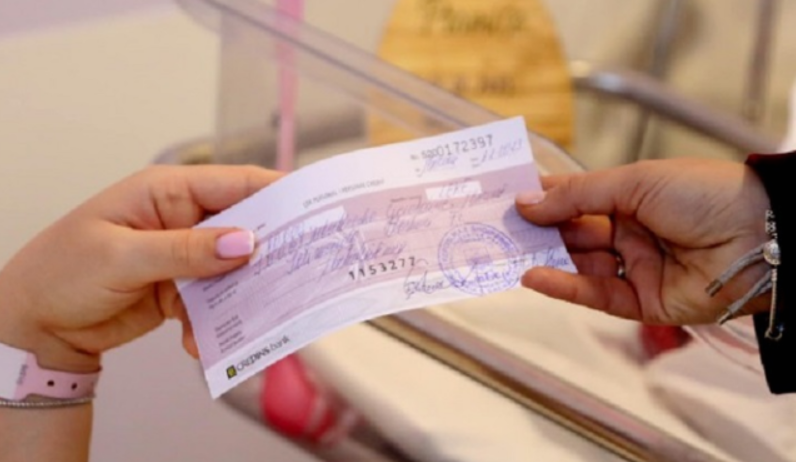
Instead of 40 thousand lek for the first child, 80 thousand for the second, and 120 thousand for the third, from July 1st of next year the state will provide money every month from the moment the baby is born until it turns 5 years old.
“The main change is that the support is no longer received all at once, but is spread over a longer period. This gives the family a predictable income and can help cover some of the expenses that arise during the child’s early years,” said Doralda Tanellari, an economic researcher.
For the first child, the payment will be 5 thousand lek per month or 60 thousand lek per year, for the second 7 thousand lek per month or 84 thousand lek per year, and for the third 10 thousand lek per month or 120 thousand lek per year. This is with the aim of “enticing” young couples to have more children.
“However, it remains to be seen whether this amount is sufficient to really influence a couple’s decision to have another child. The costs of raising a child are much higher and families also consider housing, childcare, education, healthcare and income security,” said Doralda Tanellari, an economic researcher.
In the first half of the year, 108 fewer babies were born than in January-June 2025. Data from the Institute of Statistics shows that from 10,337 last year, the number of births fell to 10,229 in the January-June 6-month period.
“The demographic problem cannot be solved with just a monthly payment. A broader package of policies is needed to make it easier for young couples to start families, have employment opportunities, child services, and a more stable economic perspective,” said Doralda Tanellari, an economic researcher.
With deaths exceeding births, Albania recorded a negative natural population growth rate… 150 more deaths than babies born.
In a reality where the number of young people and families choosing to have children is shrinking, the need for concrete supportive policies becomes increasingly greater.