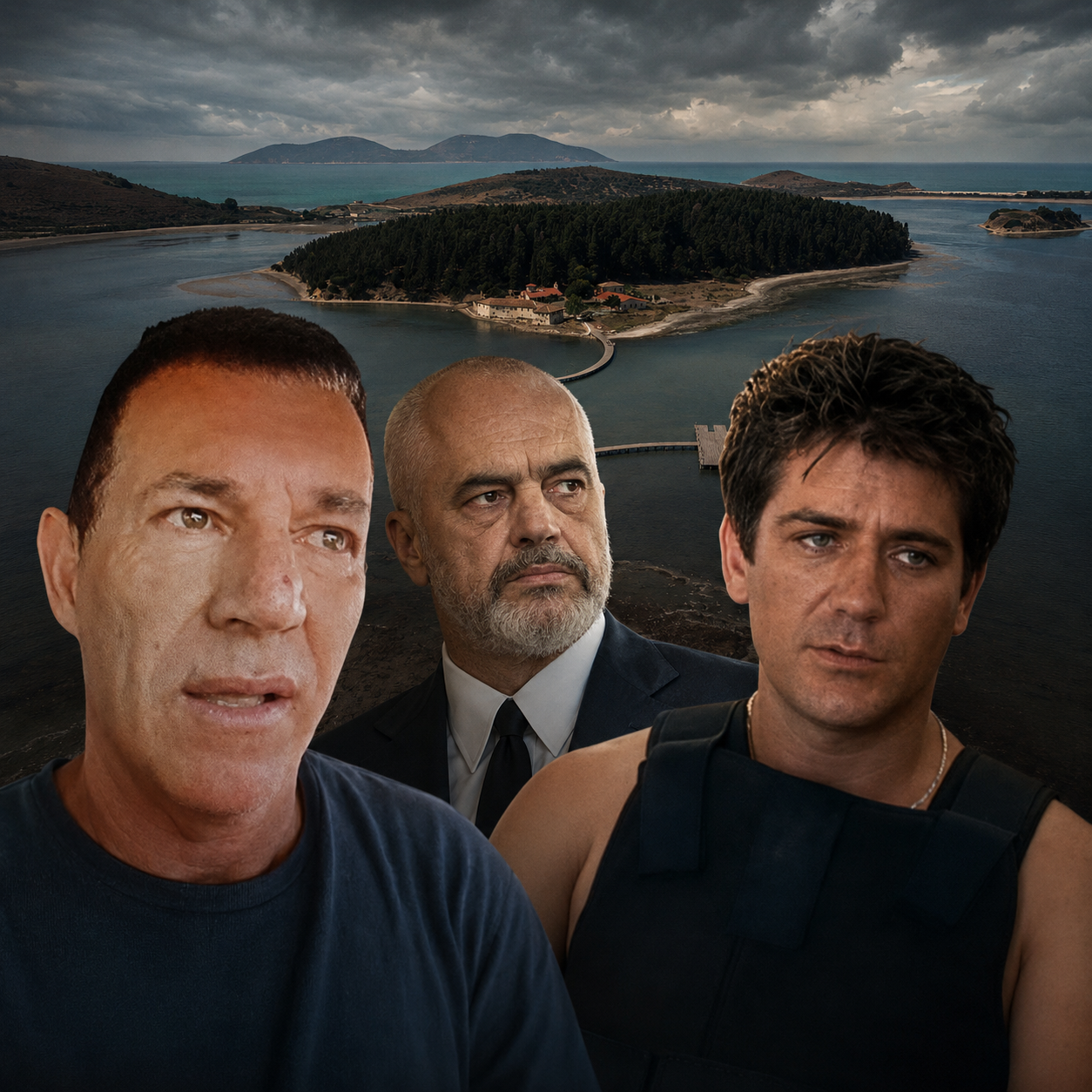
Any serious investor interested in Zvërnec, Karaburun or the Cold Water area should first negotiate with a local factor, then with the Albanian government.
We are talking about Artur Shehu, 58 years old, a character who has become the owner of hundreds of hectares of property in Zvërnec, Karaburun and the most desirable areas of Vlora, which take on a dizzying importance and value with the opening of the airport.
Artur Shehu’s emissaries to ‘take control’ of Zvërnec and other areas were initially suspected to be Pëllumb Petriti, convicted at least 3 times for the appropriation of over 800 hectares of land in Karaburun and Zvërnec with false documents, then Kreshnik Telelena, who turned out to be the owner of the forest, sand and sea in Zvërnec and in recent years Leonard Bishaj (a connection to the “Sacra Corona Unita” mafia clan).
Several articles and media investigations describe Artur Shehu as the biggest mafia boss in Vlora with 30 years of activity, still active today, under 5 names, who has lived for 23 years in Florida, USA, from where he commands the activity in Vlora, as a drug and casino boss, as a representative of the Italian mafia “Sacra Corona Unita” in Vlora, boss of the property mafia, etc.
But, in fact, there are no charges against Artur Shehu for any criminal offense.
However, several other facts point to Artur Shehu’s connections and the power of his influence all the way to the top of the government.
Shehu is the first businessman to extend the construction of a seaside resort, on the Vlora Promenade, near Uji i Ftohte and the famous government villa.
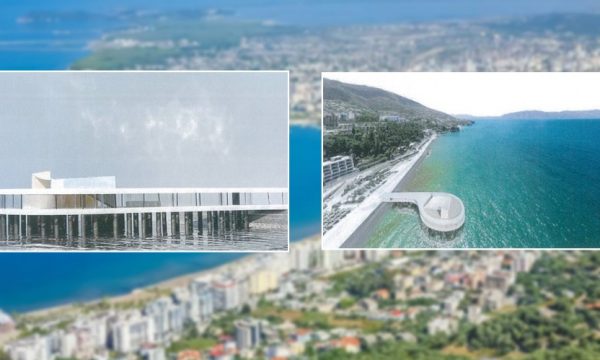
The decision was signed by Edi Rama himself on March 16, 2022 as Chairman of the National Territorial Council.
The permit was granted to the company Adhenis, owned by Artur Shehu, represented by Leonard Bishaj.
This decision shows the Shehu’s connections and influence all the way to the government, where in addition to acquiring land with questionable papers, he also manages to obtain permission to build resorts at sea, an object that not even two or three major oligarchs have the power to achieve.
Local factors in Vlora describe Artur Shehu as a serious businessman, who has been abroad for two decades.
But, if we refer to some media investigations, Artur Shehu is portrayed as a character that only SPAK, which has the support of the CIA and the FBI, can stand up to, by opening the files on how hundreds of hectares of land ended up in his hands.
OCCRP investigation
By Lindita Cela
From his apartment overlooking the picturesque Narta lagoon in southern Albania, 72-year-old Jorgaq Subashi can gaze out at the land he was given in 1993 as part of the government’s effort to return properties seized under communist rule.
But he is not allowed to live in it.
Almost three decades after regaining their land, Subashi and 34 of his fellow villagers have still not received their property deeds. They remain bogged down by seemingly unchanging bureaucracy, despite a court confirming in 2012 that their properties had been illegally transferred to a powerful local clan linked to the theft of parts of the southern coast around the city of Vlora.
“We know that the lands were taken from us by the collectivization of agriculture during the communist regime,” said Subashi. “After the 1990s, the state returned them to us, but we still can’t register them.”
The plight of the villagers is common in the Balkan nation, one of the poorest in Europe, where land reform efforts have been hampered by mismanagement and corruption. In some cases, the process has been hijacked by suspected gangsters like Artur Shehu, who, along with several of his family members, is accused of stealing nearly 500 hectares of prime real estate near Vlora.
A figure in the underworld, accused of links to organized crime in Albania and a powerful branch of the Italian mafia, Shehu fled his birthplace in 1999 after a deadly gunfight at his bar in Vlora.
He sought asylum in the US and won it in 2001. In 2019 he received his green card, paving the way for him to become a US citizen. Despite his hasty exit from Albania, he has continued to run operations there from his safe mansion on the coast of Florida.
Shehu has not been formally charged with a crime, but his associate Pëllumb Petritaj, who oversees many of his properties, has been found guilty of forging documents to obtain land in the name of the Shehu family.
Shehu’s activities are, however, well-known locally. A judicial commission described him in 2018 as “a key player” in land thefts around Vlora. When asked why no action had been taken against Shehu, despite evidence from multiple cases, the prosecutor’s office in Vlora declined to comment.
Shehu declined to answer questions about the matter. Instead, he approached OCCRP through an intermediary, who offered a reporter “ whatever he wanted” in exchange for removing the story.
But after years of keeping a low profile in his homeland and working through intermediaries, Shehu’s name has recently appeared in documents showing new business interests on the Albanian Riviera.
In 2019, he co-founded a hotel development firm called Portonova, which shares a name with a beach on the outskirts of Vlora. In April last year, he launched another tourism development firm, Adhenis. It seems that Shehu is presenting a new public image – one that is a far cry from his alleged criminal background in a city once teeming with gangsters.
Gang City
Life in Vlora in the late 1990s was crippling. Hadër Cako, who headed an investigative unit in the local police force during that period, recalls that for several years, the city was completely under the control of local gangs.
The Albanian economy collapsed after several pyramid schemes across the country were busted in 1996 and 1997 and the country descended into civil conflict, prompting an Italian-led United Nations military intervention.

Italian soldiers patrol Vlora in 1997, as part of the UN’s “Alba” operation
“The police station had no windows and no doors,” Cako told OCCRP. “The city was completely under the control of local criminal gangs. The city was a center of brutal murders, rapes, thefts.”
Shehu, dismissed from a post in Albania’s special forces, was known among the police in Vlora at the time for criminal activity, according to a former Vlora police chief who asked not to be named for security reasons.
“He had a hotel, and later built a casino,” the former official said.
Dritan Zagani, who headed the city’s anti-narcotics unit in the late 1990s, said he had collaborated with an Italian anti-drug unit investigating a crime ring with which Shehu was suspected of being involved.
“There was an open investigation into an Italian-Albanian organized crime group for acts of human trafficking and narcotics,” said Zagani.
Cataldo Motta, a former prosecutor in the southern Italian city of Lecce, which lies just 112km west of Vlora, across the Adriatic Sea, also recalled the case involving Shehu : “He is a well-known name. He was in our files as a suspect in drug trafficking.”
Shehu provided OCCRP with a June 2016 letter from the prosecutor’s office in Lecce stating that he had no prior convictions in that jurisdiction, but declined to answer questions on the matter or comment for this story.
Shehu’s time in Vlora ended after a 1999 gunfight at his bar, according to Zagan. He said gang members killed two people in the attack, including Shehu’s uncle, Luan Bedini.
“The lion died in Arthur’s arms and he vowed to avenge his uncle’s murder,” said Zagani.
He said police wanted to question Shehu about the shooting and his alleged involvement with a local crime syndicate, but he fled the scene.
According to U.S. court documents, Shehu has been a resident of that country since at least 2001, when he was granted asylum. U.S. Citizenship and Immigration Services, which processes asylum applications, said it was unable to disclose any information on the case.
In 2005, he moved to Miami, where he built a colonial-style villa overlooking a golf course, complete with columns and an ornate crest. The property is valued at up to $3 million. Florida property records show that, in addition to the four-bedroom villa, Shehu previously owned a series of condos in Miami and the surrounding areas.
Shehu’s home sits in an affluent neighborhood just minutes from the beach, with a lawn surrounded by trees. Two Mercedes-Benzes were parked in the driveway when a reporter from the Miami Herald visited the property.
In addition to dropping a letter of questions into Shehu’s mailbox, the journalist also sent him the questions via FedEx, for which someone at that address signed for them. After that, Shehu contacted a reporter in Albania through an intermediary, who offered him “whatever he wanted” in exchange for taking down the story.
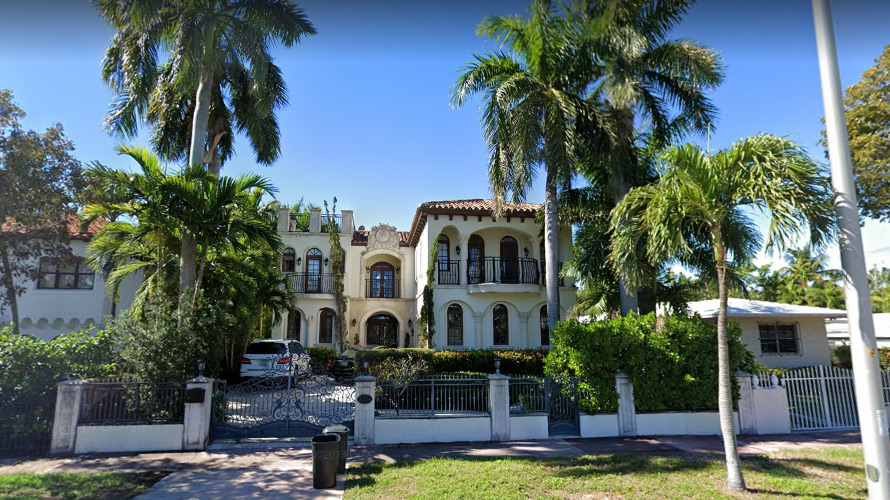
Artur Shehu’s residence in Miami
Mafia connections
Although Shehu spent nearly two decades living in Miami as a refugee, Italian anti-mafia investigators believe he continued to do business in Albania – sometimes allegedly on behalf of Italian gangsters.
Guglielmo Cataldi, another prosecutor in Lecce, said Shehu was investigated in 2012 for his role in investing money in Albania for Albino Prudentino, a long-time member of the Italian mafia organization “Sacra Corona Unita.”
An Italian court document obtained by OCCRP shows that since 2009, Prudentino rented part of a luxury building owned by Shehu in the Uji i Ftohtë neighborhood of Vlora. The Italian mafia boss ran a restaurant and an ice cream shop on the ground floor and a casino on the upper floor.
Prudentino was found guilty in 2013 of laundering mafia money through these businesses and sentenced to three years in prison. Italian prosecutors alleged that Shehu made 1 million euros by helping him do so, although they noted that they did not have enough evidence to charge Shehu.
Shehu was not charged in Italy, but Cataldi said the case against him was passed on to Albanian investigators. “We sent the data we had to Albania, telling them what the investments were, but I don’t know how that investigation went.”
The Albanian State Prosecution, the Police and the Vlora Prosecution… none of them refused to comment on the matter.
Starting in 2006, from his comfortable position in Miami, Shehu began amassing a vast property portfolio around Vlora – through means that locals say were illegal.
Although he and his family benefited, Shehu has never been directly accused of land issues. However, a close associate of his, Pëllumb Petritaj, was convicted in 2018 of falsifying land documents to usurp 187 hectares of land.
In other court cases involving a total of nearly 300 additional hectares near Vlora, Shehu and his family members are accused of seizing property through similar forgeries. This includes land on the shores of the Narta Lagoon that Subashi and his fellow villagers say was stolen from them.
In these ongoing cases, Petritaj allegedly would forge documents with the help of local officials to get the land into the hands of Artur and his father, Ramis. Sometimes a third party would take the land, then transfer it to Shehu.
Despite the lack of legal action against Shehu, at least some in the judiciary are aware of his reputation for expropriating lands around Vlora.
A disciplinary case in 2018 saw Artur Malaj, a Tirana judge who had previously served as head of the Vlora Court, dismissed for ethical reasons. Among the findings of the investigation into the judge was that at least one member of his family had purchased land from Shehu, which Malaj failed to report.
“A. Sh is suspected of being a key player in the process of alienating properties in Vlora,” the report reads, referring to Shehu.
The judge told OCCRP that only one family member had purchased land from Shehu. He said he had no knowledge of this until the investigation uncovered it and insisted that he had had no contact with Shehu.
“I have been a judge in the city of Vlora for about 10 years. In no single case have I had any property issues or other issues related to… Artur Shehu or his family,” Malaj said.
Even those with considerable resources at their disposal have been forced to make deals with the Shehu. These include a charitable foundation formed in 2014 with the mission of reclaiming the ancestral property of the Eftimiadis, a family that emigrated from Vlora to Italy in the early 20th century.
The Eftimiadi family fortune was caught up in the political and ideological upheavals that rocked Albania throughout the 20th century. In the early 2000s, a century after the family emigrated to Italy, efforts to reclaim the property fell prey to corruption and judicial inefficiency.
After discovering that part of the wealth had been taken from Shehu, the foundation’s board (which included a former Italian diplomat and a retired general in Italy’s financial police) decided to make a deal with him.
The Luca and Marco Eftimiadi Foundation signed a contract with Shehu in 2015, agreeing to accept eight apartments and three hectares of land on the coastline. None of those properties were originally part of the estate, and the foundation agreed to waive any claim to the ancestral land. Petritaj signed the contract on behalf of Shehu.
The deal quickly fell apart.
The foundation had intended to build a small marina that would generate funds for its charitable mission, which included building bridges between Albania and Italy. That plan was halted when the foundation realized the land transfer was based on forged documents, according to Namik Alimuç, an Albanian businessman who has run a bar on the property for 15 years.
“They are all fake and the whole village knows it,” said Alimuçi, who was supposed to work with the coastal development foundation.

( Coastal land near Vlora that Shehu claimed to be donating to the Eftimiadi Foundation )
Competing Claims
The Eftimiadi family’s wealth saga is just one of thousands of similar stories across Albania, caught up in a web of competing claims to land – a legacy of the communists who nationalised the property and a series of thefts during attempts to return it to private ownership.
Land issues around Vlora are particularly complicated, according to Elona Hodaj, a former director of the city’s Real Estate Registration Office.
“It’s a situation that has been created for 25 years,” she said. “There are court decisions that have awarded the same property once to one party and once to another party.”
Hodaj lasted less than a month in office. She is one of eight directors to resign since September 2019, each citing “personal reasons” for leaving.
When he came to power in 2013, Prime Minister Edi Rama vowed to resolve Albania’s land crisis and ensure that stolen properties were returned to their rightful owners.
“Albania cannot be the country that the next generation will inherit, as a place where robbers and counterfeiters enjoy once and for all the product of their criminal actions,” Rama said in 2015.
His government’s efforts have so far seen little success. Alleged land thieves like Shehu have prospered, while others like the Eftimiadi Foundation and villagers in Zvërnec, near the Narta lagoon, have been unable to reclaim their properties.
After failing to negotiate, Subashi and his fellow villagers are left with one last possible option. “We have written to every prime minister for years,” Subashi said. “We have also written to Edi Rama.”
Ina Media Investigation
By Sokol Çobo
Last summer, Dritan Koçiraj, who has had a permit for a wooden cabin on the virgin beach of Zvërnec for 15 years, had to spend it in a war with the “owner” of the beach.
During May 2021, as he applied, as he does every year, for a permit to practice his activity in this area, he was informed that the “owner” of the state property had been removed, so his permit to use the beach was denied.
Starting from May of each year until the end of September, Dritan Koçiraj turns the cabin into a small restaurant, with a few sun loungers around it. He has also employed his brother’s family in this business and with the income he enables the education of his two children.
Data provided by Investigative Network Albania shows that Kreshnik Tepelena, the former director of the port of Durres until 6 months ago, became the owner of 95,000 square meters of forest and sand by the sea in Zvërnec.
INA MEDIA has discovered that Tepelena became the owner of this large area through an unclear donation contract from Artur Shehu, who is rumored to have connections to the underworld and is suspected of being behind the theft of thousands of hectares of land in the Narta and Zvërnec areas.

He has lived in America for two decades, after fleeing Albania in 1999, following a gunfight at his bar in Vlora.
Confidential sources for INA MEDIA indicate that Kreshnik Tepelena, who has been entrusted with this highly coveted property, is a relative of Artur Shehu.
After taking ownership, Kreshnik Tepelena has declared war on two small businesses that have been operating in this area with regular permits for more than 15 years.
“After 15 years they tell us that the sea and sand are private property,” says Dritan Koçiraj to Investigative Network Albania , as he holds a “bag” of papers in his hands.
His neighbor on this beach, Sotir Tafili, is in the same situation, and has spent this summer going through trials and filing criminal charges.
“They have tired us out. We do not claim ownership of the sand and sea, if only they would let us work for rent, as we have worked every year,” says Sotir Tafili, who, like Dritani, has been in the same area for about 17 years.
“I’ve been renting it every summer for 17 years. If it were private property, why did they remember now?! This is sea, sand and forest,” he continues, while denouncing that before the start of the 2021 summer season, another citizen approached him to make an offer to leave the bar.
“Kreshnik Tepelena came and offered me 50 thousand euros to leave the business. Of course, I refused. With this small business, which I have not left anything to the state without paying, I support my family. I have 3 minor children,” says Sotiri, while also recounting the many years of wandering around to make letters.
95 thousand square meters of forest and sand have been found by the owner
But how did the forest and sand in Zvërnec become private property?!
The documents, which INA MEDIA possesses , show an unclear procedure, but which was enough to make Tepelena the owner of this property.
Initially, INA MEDIA sent a request for information to the Regional Cadastral Office in Vlora to make available to us the original registration document of this property, but this office did not deign to provide the requested information.
Despite the silence of the Vlora Cadastre, Investigative Network Albania managed to obtain the registration documents of this property from the State Cadastre Agency, Vlora, in the name of Kreshnik Tepelena, who is now the legal owner of approximately 95 thousand square meters of forest and sand on Zvërnec beach.
More specifically, according to the file available to INA MEDIA, it concerns three properties, and more specifically the properties with no. 47/227, no. 47/228 and no. 47/229, which appear to have passed in favor of Kreshnik Tepelena during 2020. Meanwhile, on 25.11.2020, ownership certificates were issued for all three of these properties.
Referring to the file on this property, which INA MEDIA has, many inaccuracies are noted.
Specifically, ASHK, Vlora says that the properties result in cadastral zone 8604, but not in Zvërnec, while their cadastral entry is forest and not grassland; while from the survey plan it is clear that part of the property is also a sandy strip.
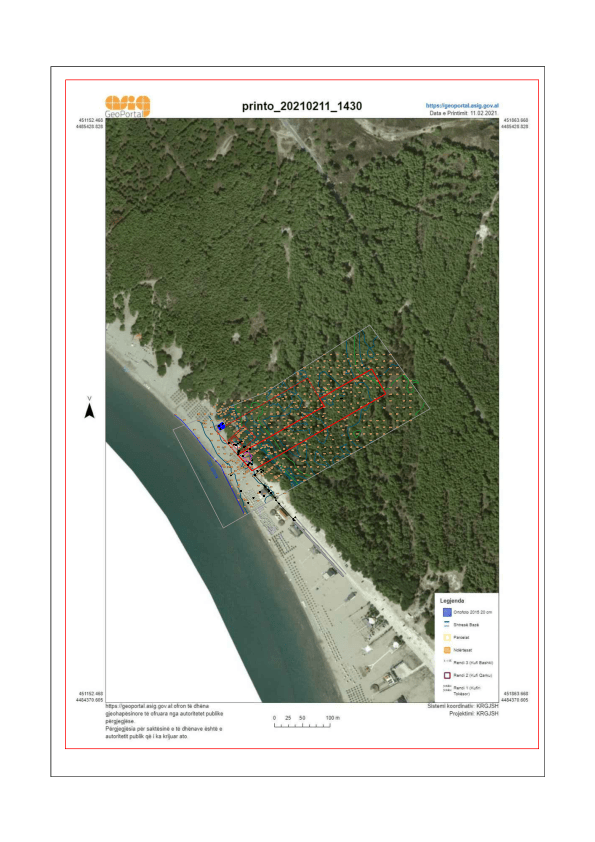
Survey document of the Soda forest, which also shows the property in conflict
As can be seen from the map, the Tepelena property is surrounded by a red line, while it extends to the sandy part of the Adriatic Sea.
“All three properties are in the name of Kreshnik Tepelena and were acquired by a donation contract and an exchange contract from Artur Shehu in favor of Mr. Kreshnik Tepelena”, – claim sources from ASHK, Vlora. This donation act also results in the relevant cards, but the way this property was registered raises strong questions about the property scandal in this area.
Referring to the file of this property, from which INA MEDIA has obtained the entire property reference for all three properties, the initial document of origin of the property registration is missing.
In this file, which INA MEDIA has at its disposal, it turns out that only these documents are in reference: “application, invoice, map ref. card, donation/exchange contract, tax form”.
But, in no case is there an initial document showing how this property was registered in ASHK, Vlora by the donor Artur Shehu.
The initial registration document is a basic document that proves the ownership and origin of the property, while in the file owned by INA MEDIA this document does not exist, but only a donation deed is made through five contracts.
The first donation contract refers to property no. 47/229 in cadastral zone 8604. It is 1200 square meters of forest and was sealed by notary Belona Seraj.
The second donation contract refers to property no. 47/227 and donates 10 thousand square meters of forest to Kreshnik Tepelena, while the third contract donates property no. 47/226, which has an area of 10,800 m 2 of forest, while property no. 47/226 makes Tepelena the owner of a full 60,150 m 2 of forest on the Zvërnec seashore, while the donation of property no. 47/228 gives it another 12 thousand square meters, bringing the total to 95 thousand square meters of donated property.

Kreshnik Tepelena’s property card in ASHK, Vlora
The documents state that Artur Shehu’s property, later donated to Kreshnik Tepelena, who has held several state positions and was recently one of the top managers at the port of Vlora, was acquired in November 2020. The five property cards state that the property is “forest”, while in no case does it appear to be a meadow, unlike what the survey plan shows.
The Vlora Cadastre has often been at the center of accusations of property alienation on the coast, becoming a curse for the leaders of this institution, which changed 10 directors in less than a year. One of them even set the record as the shortest-lived director, remaining in the position of director of the Vlora Cadastre for only 4 days.
The impasse was also acknowledged by the head of the cadastre, Artan Lame, describing Vlora as the most problematic, as a result of issues carried over in recent decades.
“The Vlora Cadastre is the most problematic institution in the country. We are removing the remnants of 25 years of mockery of the people,” Lame declared in 2020 .
In August 2021, SPAK landed at the Vlora Cadastre and seized some of the hottest property files in the south. Shortly after, in October 2021, the former director, Klodian Troci, was arrested as part of a group forging property documents in Dhërmi.
The sand became a “bone of contention”
The area in which Sotiri and Dritani operate is near the Adriatic Sea, north of Vlora, an area known as the Zvërnec forest.
Both citizens have been provided with a permit to use the beach area for many years, initially from the former Qendër municipality in Vlora and, after the territorial reform, from the Municipality of Vlora.
“It has always been state, public property. Never private,” insists Sotiri, while also reviewing the decisions he has made in the past.
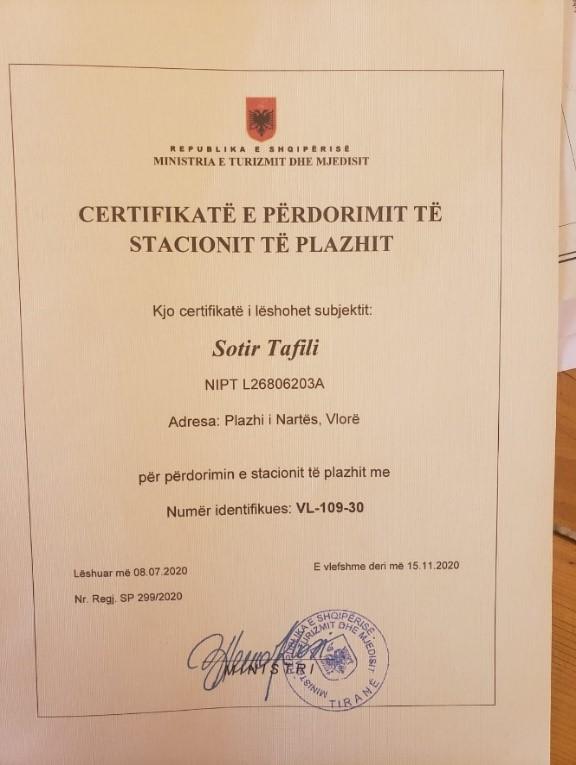
Certificate of use of the beach station in 2020 for Mr. Sotir Tafili
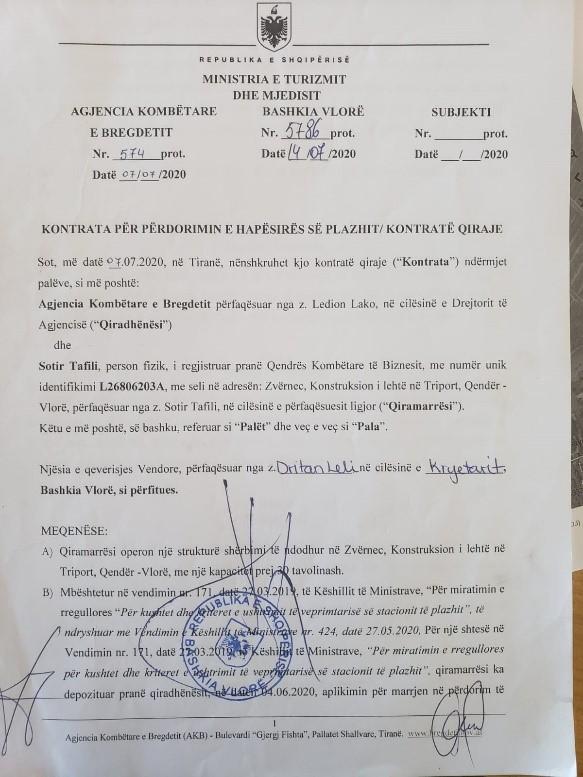
Mr. Sotir Tafili’s contract for the use of the beach throughout 2020
According to documents available to Investigative Network Albania , Sotir Tafili was granted a permit to use the beach area in Zvërnec, Vlora, in 2020.
It is a certificate of use of the beach station, which was issued with the address “Nartës Beach, Vlorë”. The certificate is valid until November 15, 2020, while at the end it bears the signature of former minister, Blendi Klosi.
Following this certificate, Tafili was provided with an environmental permit from the National Business Center, while also paying the fees set by the Municipality of Vlora.
“They never told me it was private property,” he says, as he continues to practice his activity.
According to another document, dated March 17, 2021, Sotir Tafili learned that a report from the Territory Protection Inspectorate of the Municipality of Vlora was issued in his name for the finding of a misdemeanor.
“A building with wooden construction, covered with a roof, about 230 m 2 , built a long time ago,” the document states.
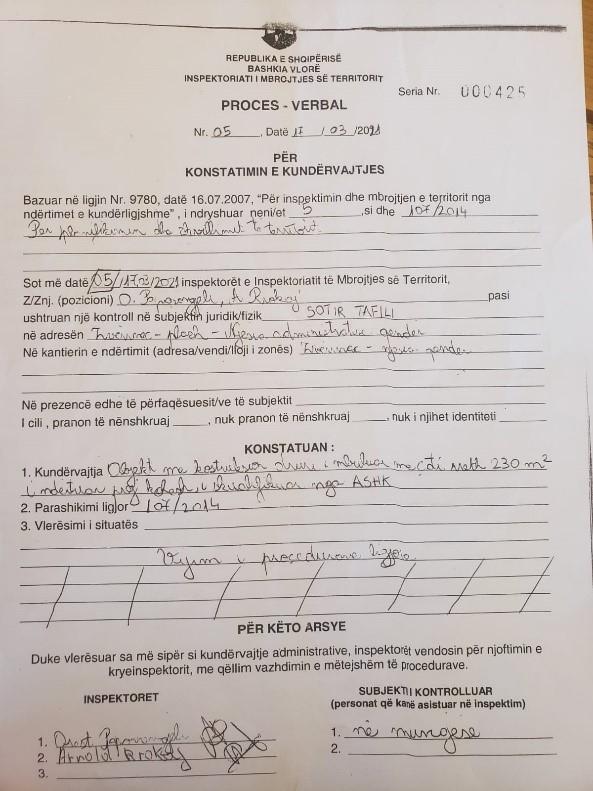
Facsimile of the IMT document, Vlora
“Immediately after this announcement, which came to me from the IMT of the Municipality of Vlora, I learned that the territory where I was carrying out my activity, which is the sea, sand and pine trees, had been acquired by its owner. The property was claimed by Kreshnik Tepelena, who asked me to sell the activity to him,” Sotir Tafili tells INA MEDIA .
During the same period, he also learned about the condition of his neighbor’s property, Dritan Koçiraj.
“He showed us some photocopies of some property cards, accompanied by maps, that the property where we operate is private. I don’t know who issued these documents,” they say.
Referring to the survey plan for this area, it seems clear that the alienated property also includes a strip of farmland, while the law clearly states that sand by the sea cannot have an owner.
Unlike what happened with this property, Law 8743, of 2001 , on “Immovable State Properties”, in Article 3, states: “The following belong to the state and are part of public immovable properties: a) coastlines for entering land, territorial waters and banks of rivers, streams and other watercourses, lakes, lagoons and natural or artificial reservoirs, islands and accumulations of sand, stones and soil in the beds of rivers, lakes and reservoirs, as defined by the laws in force.”
Meanwhile, point 2 of this article states that ” forests, pastures and meadows, as well as any other type of immovable property built on them, which directly serves their protection and development, are also public immovable properties .”
So, Article 3 states that the sandy area belongs to the state, while it says that “the forest is state property.”
Point 20 of Article 4, Law 20, of 2020 , clearly defines that “coastal sand” and “beach” are the land areas along the coastal strip and that constitute public, inalienable property, according to the Civil Code and the legislation on state immovable properties.”
Yes, what is inalienable, public property? Point 19 of this same article clarifies that “inalienable public property” are public assets that cannot be transferred to the ownership of private law entities”, an article that was violated by the Vlora Cadastre in the registration of this property.
Institutions threw “gasoline on the fire”
The clash over “ownership” has also led to fierce clashes over the use of this beach between Kreshnik Tepelena and Sotir Tafili and Dritan Koçiraj, even accompanied by criminal and civil charges and lawsuits.
In 2021, Tafili and Koçiraj applied again for use of the beach to the Ministry of Environment and Tourism and the Municipality of Vlora.
But, after applying, Sotir Tafili received a response from the Ministry of Environment and Tourism, which reads: “Regarding your application no. 60a45157002df for Beach Station no. VL-41, we inform you that: Your application has been rejected! Your application has been rejected, as the plot is private property.”
INA requested information from the Municipality of Vlora, asking about the procedures that citizens must follow to obtain a beach use permit for 2021.
“The Municipality of Vlora is not the competent institution that can respond to you, since since May 2022 the management of public spaces – beaches – is carried out by the Ministry of Tourism and Environment together with the National Coastal Agency,” the response from the Municipality of Vlora states.
Further, to the question of whether sand and forest are considered public property, this municipality answers: “Public property is all property that enjoys the legal status of a state and is owned or administered by a specific state body . ” But without specifying whether the sand of the Adriatic coast is public property or not.
INA also contacted the Ministry of Tourism and Environment, which states that, in accordance with the Council Decision No. 1172, dated 24.12.2020 “On the conditions and criteria for exercising the activity of a beach station, as amended…”, the application for a beach station is made on e-albania .
According to her, the National Coastal Agency approves the stations.
“From the AKB’s verifications, it results that (GTSHA), as the authority responsible for reviewing applications for the exercise of activity as a beach station, has sent to AKB the approval for the subject Dritan Koçiraj, plot VL-29, for a period of 1 year. Regarding the subjects Sotir Tafili and Kreshnik Tepelena, AKB has no information regarding their application, as it has not received approval from (GTSHA) to continue with further procedures for signing the contract,” the response states.
Meanwhile, Tafili says he has gone to the Vlora Municipality several times to get the bill, but they tell him that Kreshnik Tepelena, who owns property, has also applied.
“You have to have a photo to apply. He used the photos of my bar with his name and applied to take this beach station with my blood. Now, what can I call this?! Robbery, a threat, that you won’t be here tomorrow?!” – claims Sotiri, while saying that the Municipality of Vlora was also aware of this problem, since “the Tepelena property lies on the sandy part”.
Despite the conflicting situation, neither the Cadastre, nor the Municipality of Vlora, nor the Ministry of Tourism and Environment intervened to quell this conflict. With their actions and inactions, they added fuel to the fire, aggravating the situation.
“Sunbed War”, police count reports and clashes
Tafili and Koçiraj spent the summer of 2021, from June 2021 until the end of the season, amidst strong clashes with the “owners” of the sand.
“They have used every means to get us out of here,” Koçiraj and Tafili say in unison, as they claim that they have also physically clashed with Kreshnik Tepelena, issues that have reached the doors of the Vlora Prosecutor’s Office and Police.
Referring to the official response to Investigative Network Albania , it seems clear that the Vlora Police have only counted the criminal incidents for “sun loungers”.
“In response to your request for information, we would like to inform you that the State Police has referred the materials to the Prosecutor’s Office at the Court of First Instance, Vlora, for several cases in this area,” the police say.
According to her, on June 17, 2021, citizen Kreshnik Tepelena was criminally prosecuted for the criminal offense of “Forgery of documents”, as he is suspected of having forged documents to obtain a forest area in Zvërnec.
Meanwhile, Sotir Tafili was prosecuted on June 30, 2021 and July 6, 2021, “after being found occupying public space, placing beach umbrellas without the permission of the competent authorities on the beach of Zvërnec.”
Koçiraj also had the same procedure, who was processed on July 8 and 14 for “occupying public space.” In all the references, the police say that they “occupied public space” and not “occupied private space.”
Also, the police say that on July 25, 2021, citizen Kreshnik Tepelena was criminally prosecuted for the criminal offense of “Obstruction of the execution of court decisions”, after he committed actions contrary to the decision of the Administrative Court, preventing citizen Sotir Tafili from exercising his activity at his beach station, as well as citizen Josif Koçiraj for the criminal offense of “Self-judgment”, after he did not allow citizen Kreshnik Tepelena to exercise his activity at his beach station.
But, what is the beach station that Kreshnik Tepelena has?
The National Coastal Agency explains to INA MEDIA that “the Tepelena entity has not received approval”, which means that Kreshnik Tepelena does not have an approved beach station, nullifying the actions of the Vlora Police.
The police are often unclear in their list of proceedings, as they sometimes prosecute Kreshnik Tepelena for document forgery and other times beach users for occupying “public property”.
Meanwhile, INA also requested information from the Vlora Prosecutor’s Office, which in response said that “materials have been referred to the criminal offense of “Land Invasion”, for which decisions have been made not to initiate the case by the prosecutors.”
The prosecution further claims that “from the verification of the register, it does not result in any criminal proceedings for these facts against citizen Kreshnik Tepelena, since in some cases he is the accuser for the criminal offense of “Land Invasion”. Therefore, the two law enforcement institutions give different answers.
INA MEDIA attempted to contact Kreshnik Tepelena, but it was not possible. However, in a statement to the media a few months ago, he stated that “my property goes all the way to the sandy part.”
And, after months of clashes with the institutions, the two citizens have surrendered.
“We couldn’t, they prosecuted us and threatened us. Even though it was public, state property, they forcibly removed us from there. They achieved their goal,” Tafili and Koçiraj conclude.