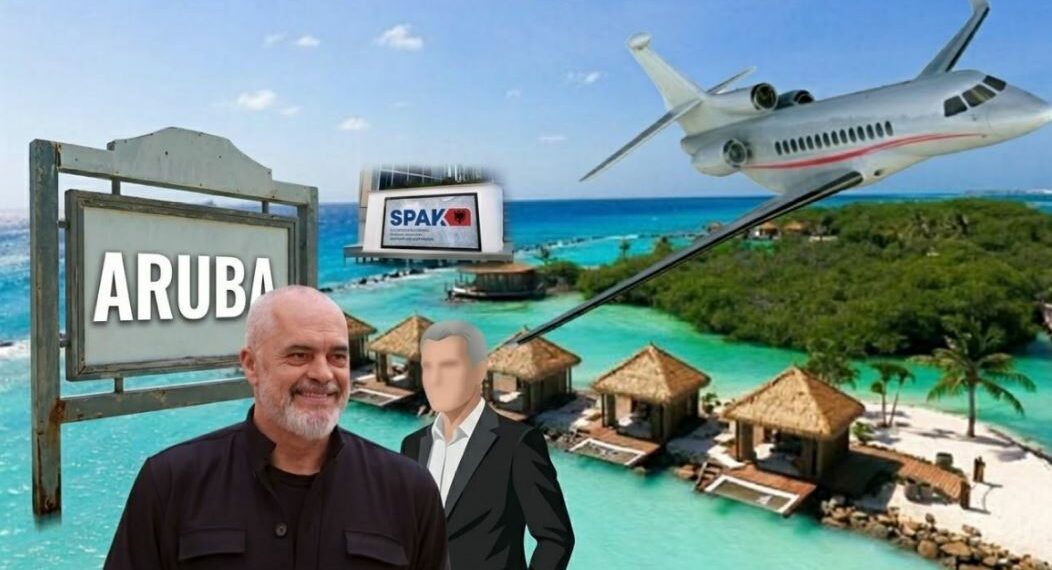
For years, the meeting on the remote Caribbean island of Aruba held the status of a mysterious piece of evidence in the secret files of European police. Today, this episode is no longer a corridor rumor. It has become the main node of a major investigation by the Special Anti-Corruption Structure (SPAK), which has gone into the field, hitting a powerful network of international cocaine trafficking and money laundering in luxury resorts in the south of the country.
But while the names of the crime figures and businessmen involved are being revealed day by day through SPAK raids and seizures, the question hanging over public opinion remains the same: Who is the high-ranking state official who sat at the same table with the cocaine bosses in Aruba? The beginnings of this scandal take place in the reports of the Anti-Mafia Investigative Directorate (DIA) in Italy.
Italian investigative journalist Nello Trocchia, who has extensively researched this dossier, has publicly stated that the data about this meeting is irrefutable and is based on telephone and environmental wiretaps conducted by European authorities.
According to this data, the meeting took place around 2019 in Aruba. At that table, where drug trafficking leaders were present (including names linked to well-known exponents such as Artur Shehu or profiles investigated for trafficking tens of tons of cocaine), “exponents from the Albanian government” also participated. According to European police intelligence data, this meeting did not only discuss drug routes from Latin America, but specifically about major construction and investments in Albania.
What does the SPAK file say?
In the decision to impose a security measure on 20 people, part of a criminal group that supplied cocaine to Europe, the traffickers rise above the level of provincial strongmen. They appear as powerful transnational structures, with connections in Latin America, European ports, processing laboratories, front trading companies, cash, bitcoin and haWala payment systems, as well as millions of euros ready to be injected into the Albanian economy through construction.
According to the dossier, their activity extended from Colombia, Ecuador, Bolivia, Suriname, Paraguay, Uruguay, Puerto Rico and Brazil to the ports of Antwerp and Rotterdam, through fruit, meat, coal and soy companies. SPAK says the cocaine was hidden in containers, processed in warehouses in Belgium and the Netherlands and then distributed to several countries in the European Union.
The dossier states that the traffickers had formed alliances with “Dutch, Belgian, Turkish, Israeli, Italian, Polish, Brazilian, British groups, as well as drug cartels from Colombia, Paraguay and Ecuador.” So, it is not a local group, but an international network that controlled the trade chain, from cocaine production to the European market.
In one part of the file, SPAK estimates that for Luciano Koceku alone, the payments made in the context of this activity amount to “a total value of 12,635,670 euros, 14,192,689 pounds, 5,035,000 dollars and 1.5 million pesos”. The quantities of drugs in question are equally large. The file mentions 441 kilograms of cocaine seized in Barcelona, 162 kilograms in England, 1,435 kilograms in the port of Rotterdam, as well as several other seizures that, according to SkyECC communications, are related to “600 kg”, “1.2 tons”, “1 ton” and another “1 ton”.
Photos in Aruba
From documents from Spanish, French, English authorities, etc., it is difficult to determine a clear hierarchy in the structure of criminal groups. People like Artur Shehu, Alfredo Hamzai or Luçiano Koçek turn out to be more collaborators than subordinates of each other.
However, in the file, prosecutors single out two names: “The persons under investigation Alfredo Hamzai, Luçiano Koçeku, who are leaders of criminal groups that traffic narcotics, enable various chains of criminal activity by having full control over the source from which the narcotics come, the points where they will transit and then in the transportation to the warehouses”. The file states that the data consists of “meetings held in Mallorca, Belgium and Aruba, meetings which consisted in the years 2018-2021 mainly within the framework of the criminal activity of narcotics trafficking, but also for investments in Albania”.
In another part, the document is even more direct and speaks of “performing notarial actions on the purchase of real estate, investing directly or hidden behind construction entities known in the construction activity and which easily obtain development and construction permits as a strategic investor.”
This is the main point of the file: the groups that, according to SPAK, trafficked tons of cocaine sought to enter Albania through construction, property and strategic investments. Not as anonymous citizens who buy an apartment to hide some money, but as actors who sought to dictate the sector most dependent on the state: permits, coastal developments, licenses, property registrations and special statuses. It is in this context that the meetings held in Aruba take on particular importance.
According to the summary sent by the Belgian authorities, meetings were observed in January-February 2019 in which some of the persons under investigation participated. The file cites: “on the island of Aruba (Netherlands Antilles), from 24 to 31 January 2019, attended by ISMAILAJ Arben, MEMETI Elton, RAMA Adrian, SHEHU Artur and SHEHAJI Bujar”. See the photos below:


High State Representative in Aruba
In the same section, where foreign authorities are cited for investigating the “Black Eagle” operation in Spain, the file adds a much stronger political element. It states that Belgian authorities have received “data on meetings held by them with high-ranking Albanian state officials in Aruba.”
However, the name of this senior official does not appear in any fragment of the file, a fact that leaves room for interpretation. Who is the senior official who was in Aruba? Why does SPAK not publicly identify him? The file does not say whether the official was questioned, investigated or excluded from suspicion. But the fact that the document itself mentions “representatives of senior state officials of the Albanian state in Aruba” is enough to raise a serious investigative and political question: Was the official’s name intentionally left out, or is the investigation still at a stage where SPAK has not documented his role?
This question is made even stronger by the way the Belgian authorities describe the meaning of these meetings. The file states: “According to the partial evidence presented, these meetings appear to be related to real estate projects in Albania, potentially financed with illicit funds, with the support of political authorities.”
If the meetings were related to real estate projects in Albania, if the financing was suspected to come from illegal funds, and if “support from political authorities” is mentioned, then the high-ranking state official takes on an important role in the investigation. He is the link that can explain how drug traffickers managed to condition important economic policies for the country.
Traffickers with the state at their disposal
The dossier provides the answer in several directions: to purchase properties, to secure development permits, for licenses, for strategic investments and for legalizing money through the construction industry. SPAK says that the laundering was carried out through the purchase of real estate, concealment of ownership, fragmentation of properties, alienation and then granting of land to construction developers.
The file states that this mechanism was intended to “make it more difficult to trace and benefit from these, by avoiding and severing the link between the initial beneficiary” and the “final beneficiary”. It further explains that the lands were given to construction entities “by integrating and mixing in this way illegal income with legal ones, proven in some cases with the full knowledge of the construction entities”. This is why a high-ranking state official was valuable to such a group.
charges
Direct accusations have been made by Sali Berisha and the opposition, who have stated that the file received from foreign investigators is complete and that a person very close to Prime Minister Rama has traveled to Aruba. The most talked about name is that of Engjëll Agaç. But not only that. According to Berisha, there is talk of the presence of three people. “The names that are being said are Damiani, who did not keep from taking the oath.
“Olsi, Rama is tall. Rama is also owned by Bale’s sons, but it’s not them. The tall one is Olsi, or Rama himself, I can’t say that, but as far as I know it’s Olsi and the third is Engjëll Agaçi. The last one, there’s not one meeting, but there’s more than one meeting in Aruba. And the 600 thousand euros that was made for Edi Rama, according to the Belgian file,” Berisha told reporters two days ago outside parliament.
Logically, no government official could dare to fly to Aruba to sign an agreement with the mafia without the authorization of the head of government. On the other hand, referring to the wiretaps where codes or physical descriptions are spoken (e.g. the epithet “tall”), there is insistence even within the Laws Committee in the Assembly to urgently call the leaders of SPAK to release the official names to the public.